Weight-loss drugs based on GLP-1 receptor agonists are experiencing a real boom. Ozempic and Wegovy have become some of the most talked-about medications in recent years thanks to their ability to reduce appetite and help manage body weight. However, as demand has grown, so has attention to their safety. Despite their proven effectiveness, these drugs have side effects, and some potential risks are still being studied.
On November 9, 2026, the U.S. Food and Drug Administration (FDA) required the labeling for Ozempic and Wegovy to be updated with a warning about the possible risk of a rare but serious eye condition–non-arteritic anterior ischemic optic neuropathy (NAION). This condition occurs when blood flow to the optic nerve is disrupted and can lead to irreversible vision loss.
This is not a ban on the drugs, but an additional warning for doctors and patients. According to the FDA’s analysis, the complication is rare. At the same time, the available data do not support treating the risk as the same across all drugs in the GLP-1 class. The new warning underscores the importance of assessing not only the benefits of treatment, but also its potential consequences.
What will change in the Ozempic and Wegovy labeling
According to the FDA announcement on November 9, information about the potential risk of NAION must be included in the warnings and precautions section. The regulator’s list includes 12 brand names, including Ozempic, Wegovy, and Rybelsus, which contain semaglutide, as well as Mounjaro and Zepbound, which contain tirzepatide.
Ozempic is used to treat type 2 diabetes, while Wegovy is prescribed for weight management when indicated. Semaglutide activates GLP-1 receptors, which are involved in regulating blood sugar and appetite. It increases insulin secretion in response to rising glucose levels and helps reduce food intake. Tirzepatide also acts on receptors for another hormone, GIP.
These are medications supported by clinical data and should be distinguished from experimental products in the field of peptide biohacking. However, a drug’s approval does not rule out new information emerging about rare adverse reactions after it comes into widespread use.
In June 2025, the European regulator EMA recognized NAION as a very rare side effect of semaglutide. The U.S. requirement is broader: it applies to the entire list of drugs identified by the FDA, not just semaglutide.
What is NAION, and what are its symptoms?
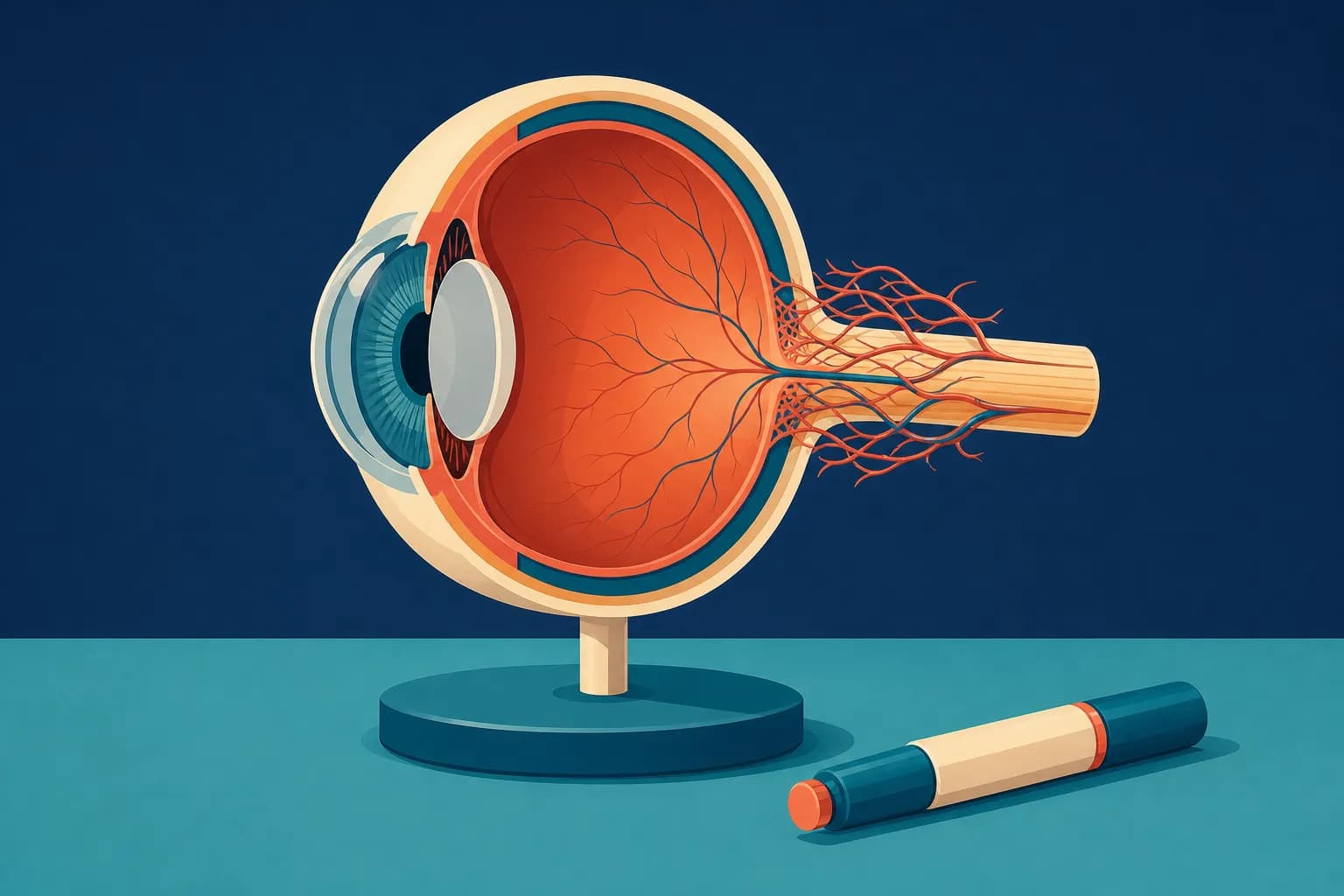
The optic nerve carries signals from the eye to the brain. In NAION, blood flow to its front part becomes insufficient, which can damage nerve fibers. The term “non-arteritic” means that the disruption is not caused by inflammation of the arteries.
Vision usually worsens suddenly and without pain. A person may notice darkening, blurring, or the loss of part of their field of vision. Vision loss can be persistent, but its severity varies: a diagnosis does not automatically mean complete blindness.
Type 2 diabetes itself increases the risk of NAION. The UK regulator MHRA also lists smoking, high blood pressure, and high cholesterol as risk factors.
As a result, people prescribed these medications may already have a higher baseline risk before starting treatment.
How rare is the risk of vision loss?
The FDA pooled data from 126 randomized clinical trials involving more than 134,000 patients. The regulator identified just 15 probable cases of NAION: ten among people taking GLP-1 drugs and five among those taking a placebo.
The incidence was 6.4 versus 3.8 cases per 100,000 person-years in the GLP-1 drug and comparison groups. The comparison groups included people taking a placebo or other glucose-lowering medications.
Person-years account for the duration of follow-up: 100,000 people followed for one year contribute 100,000 person-years. The difference between the reported rates is about three cases for that amount of follow-up. This is not 6.4% and is not the probability of losing vision over an entire course of treatment.
The small number of events limits the precision of the estimate. These data help put the scale of the risk into perspective, but they do not allow us to predict it with confidence for an individual patient.
Why an association with a drug does not prove causation
One of the early signals came from a study by Jimena Tatiana Hathaway and colleagues, published in JAMA Ophthalmology in July 2024. Among patients at a specialty center, semaglutide use was associated with a higher risk of NAION: approximately four times higher in the group with diabetes and eight times higher in the group with overweight or obesity.
This was a retrospective observational study at a single center. Its participants were not representative of all semaglutide users, and treatment was not randomly assigned. Diabetes, vascular disease, and other differences between patients could have influenced the results, even after statistical adjustment.
In the FDA Sentinel observational study, the conclusion depended on which treatments the GLP-1 drugs were compared with. There was no statistically convincing difference when they were compared with SGLT-2 glucose-lowering drugs; when compared with the DPP-4 group, the risk was higher. This makes it difficult to distill all the available data into one definitive assessment.
The biological mechanism behind possible drug-related damage has not yet been established. However, regulators do not need to wait for definitive proof of causation before issuing a warning: the seriousness of the potential complication also matters.
What symptoms require urgent care?
Sudden vision changes require immediate medical attention, even if the eye does not hurt. According to MHRA guidance, anyone experiencing sudden vision loss, including partial loss, or a rapid worsening of vision should seek urgent eye care or go to an emergency department.
Other symptoms that warrant urgent assessment include:
a new “blind spot” or loss of part of the visual field;
tunnel vision, when the visible area suddenly narrows;
sudden blurring or a change in color perception.
You cannot determine on your own whether symptoms are caused by NAION: sudden vision changes can have other causes that also require urgent treatment. Do not wait for a routine appointment or for pain to develop.
If you have no new symptoms, this news alone is not a reason to stop taking your medication. Discuss your eye conditions, vascular risk factors, and the benefits of treatment with your healthcare provider. An individualized assessment of potential benefits and harms is also important with other types of treatment, such as choosing estrogen patches for menopause.
Recommendations from regulators differ for confirmed NAION. The EMA and MHRA recommend stopping semaglutide; the FDA advises doctors to consider discontinuing it if the benefits do not clearly outweigh the risks. A doctor makes the decision about ongoing treatment based on the diagnosis and the medication being used.
Are NAION and diabetic retinopathy the same thing?
No. NAION affects the optic nerve, while diabetic retinopathy damages the blood vessels in the retina. These conditions require different diagnostic approaches; they cannot be distinguished based on a description of blurred vision alone.
If one eye is affected, will the other eye inevitably lose vision too?
No. An affected eye does not mean that vision in the other eye will inevitably be lost. Once the diagnosis is confirmed, an ophthalmologist will assess both eyes and discuss follow-up care.
Can NAION be prevented simply by lowering the dose?
The available data do not identify a dose that eliminates this risk. Do not change your treatment plan on your own: if you have no symptoms, discuss the question with the doctor who prescribed the medication; if your vision suddenly worsens, seek urgent care.