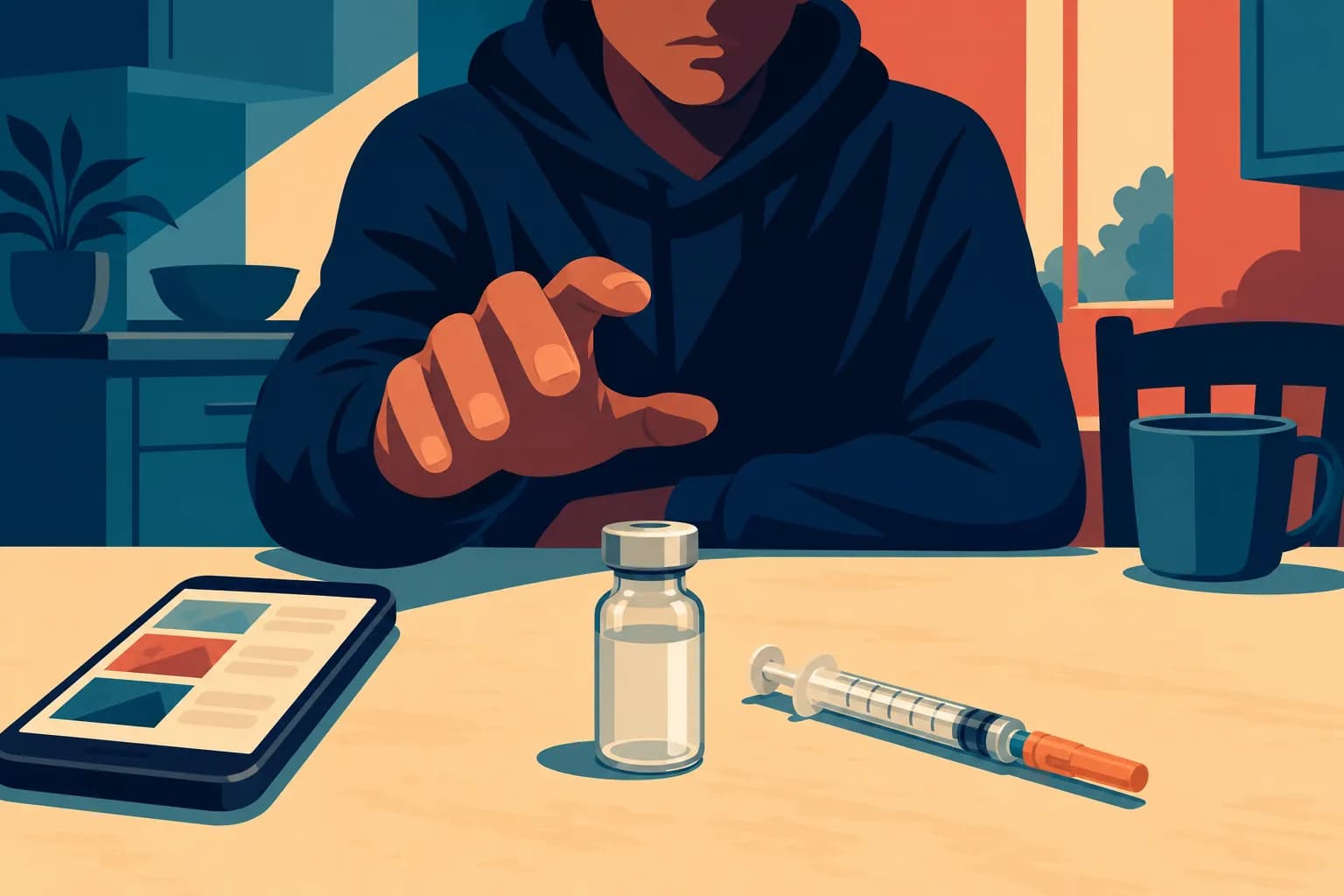
Retatrutide — a breakthrough for weight loss or a risk to life?
Published on: ⋄7 min read
On October 13, 2026, CBS News published an investigation by Daniel Gilbert: the FDA, the U.S. Food and Drug Administration, had received two reports of deaths following the use of products sold as Retatrutide(LY-3437943). It is an investigational triple agonist for weight loss—a substance that activates three types of receptors. As of October 17, the drug has not yet been approved for general use.
A causal link between these products and the deaths has not been established. However, it is worth avoiding purchases of “retatrutide” through social media and unofficial sellers because the ingredients, concentration, and quality are unknown. The label on a vial does not confirm that it contains the drug being studied by its developer, Eli Lilly.
What is known about the two reports to the FDA
According to a review of published FDA forms by BariatricPal / Obesity Treatment News on October 14, 2026, the first report was received on July 12 and described an event on July 10. The second was received on September 9 and concerned an event on September 3.
On October 13, Becker’s Hospital Review recounted the circumstances of both cases. The first report described cardiac arrest in a 41-year-old woman with obesity who had obtained the product from an unreliable source. The second described the death of a 49-year-old patient after severe dehydration, malnutrition, and cardiac arrest. According to the person who submitted the report, the vials had been sold to her by a nurse who also recommended dosages.
There are additional circumstances: according to the BariatricPal review, the first report also listed kava—a herbal product the woman had used around the time of the initial event—among the suspected products. This is another reason not to reduce the story to a single explanation.
Details of the cases are known through secondary publications; the original forms have not been independently verified here. The published reviews do not include chemical analyses of the vial contents, confirmation of the dose administered, or a conclusion about causality. According to Becker’s, the FDA did not respond to CBS News about whether it had reviewed the two cases. This does not allow us to draw conclusions about the outcome of a review or whether an investigation is underway.
A report of a death is a reason to examine the risk. On its own, it does not prove that the substance named on the packaging caused the death.
It is also impossible to calculate the likelihood of death from these two reports: the number of people who used similar products is unknown. Spontaneous reports may be incomplete or duplicated.
Why retatrutide is called “triple”
Retatrutide is a single molecule that activates GIP, GLP-1, and glucagon receptors. An agonist is a substance capable of activating a receptor. So this is not a mixture of three drugs in one syringe.
These receptor systems are involved in regulating appetite, glucose metabolism, and energy metabolism. But the word “triple” says nothing by itself about the safety of a particular vial or what dose may be appropriate for a person.
In information updated in September 2026, Eli Lilly describes retatrutide as an investigational drug that has not been approved by any regulator. On June 6, 2026, the American Diabetes Association reported on the phase III TRIUMPH-1 study: 2,339 participants comparing weekly injections with placebo over 80 weeks.
Participants in clinical trials receive the drug under a protocol, undergo screening, and are monitored. The results of such a study cannot be applied to powder from an online store. It is also inaccurate to call the vials being sold “tested equivalents” or “cheap generics”: retatrutide has not yet been approved.
Why the name on a vial does not guarantee what is inside
Without verifying a product’s source, it is impossible to know whether the vial’s contents match the seller’s claims.
A buyer sees neat packaging, a batch number, and sometimes an accompanying certificate. But without a verifiable source for the product, questions remain: what substance is inside, how much is there, are there contaminants, and were storage conditions maintained?
Lilly warns that illegal products sold under the name retatrutide may contain unknown ingredients, contaminants, a different active substance, or a dose that is too high or too low. The company has a commercial interest in its own drug. Its warning describes possible risks and does not replace laboratory analysis of the vials mentioned in the two death reports.
There is also an independent regulatory position: the FDA warns about the unknown quality of research peptides sold to consumers. A “for research use only” label does not make a product suitable for injection into a person.
In a letter to the seller GenLabMeds dated September 9, 2025, the FDA called claims about an FDA-approved retatrutide dosing regimen and its equivalence to the active ingredients in well-known medicines misleading.
Under U.S. federal law, retatrutide cannot be used to compound drugs in pharmacies either. Selling it through a healthcare professional does not remove this restriction. The FDA’s legal position applies to the United States; it should not automatically be applied to Russian or other laws.
How supervised treatment differs from buying a vial
A self-administered injection may be part of prescribed treatment; unknown ingredients and a lack of medical support change the risk.
Giving yourself an injection at home does not in itself mean you are engaging in dangerous self-treatment. Patients can self-administer some prescribed medicines after receiving training. The difference begins earlier—with the choice of medication, an assessment of health, and a clear monitoring plan.
Situation
What is known about the drug
How the dose is chosen and the response monitored
Prescribed, approved medicine from a licensed pharmacy
The ingredients and dosage are listed in the official prescribing information
The doctor takes the patient’s health into account, explains how to use it, and adjusts the treatment
“Retatrutide” from an unofficial source
The name on the packaging does not verify the contents
A seller’s advice is no substitute for a prescription; an unknown concentration makes it difficult to assess the amount administered
Errors are possible even when using a known substance. The FDA has described cases involving compounded semaglutide: when drawing it from a vial themselves, patients administered doses 5–20 times higher than prescribed. Some required hospitalization. The agency linked the errors, among other things, to confusion between units of measurement and insufficient training.
These cases involved semaglutide. They illustrate the risks of handling vials, but they do not explain the cause of the two reported deaths and are not statistics on retatrutide complications.
Which offers to buy should raise concern
It is understandable to want to find affordable treatment, especially when weight affects your health and prescribed therapy is too expensive. But a discount does not answer questions about what is in the vial. See whether any of these descriptions sound familiar:
I am being offered an injectable drug without a prior medical assessment or a prescription.
The packaging says “for research use only,” but the seller sends a person an injection schedule.
I am being promised an “FDA-approved retatrutide dosage.”
I cannot verify the pharmacy, manufacturer, or source of the batch.
The dose is being selected over messages, without asking about my health conditions or other medications.
After paying, the seller is the only person I can contact; there is no doctor I can tell about side effects.
The FDA specifically identifies the absence of a medical assessment, a prescription, and an accessible doctor to answer questions as warning signs of an online service. A seller’s professional credentials, chat reviews, and photos of customers who have lost weight do not confirm the product’s quality.
If you have already bought or injected an unknown drug
Do not inject another dose of an unknown product, and contact a doctor. Do not try to choose a replacement or recalculate the dose yourself based on advice in a chat. Keep the packaging, vial, messages with the seller, and payment information. Write down when you injected it, the concentration listed on the label, and how much solution you drew up—even if you only know approximately.
Seek urgent medical care for chest pain, difficulty breathing, fainting, confusion, or severe or worsening abdominal pain. Repeated vomiting and being unable to drink also require urgent assessment: do not wait for the weakness to become severe.
If you have no symptoms, that does not confirm the contents are safe. Discuss what to do next with a doctor and report the suspicious product to your local medicines regulator.
At your appointment, you can say plainly: “I injected a drug from an unofficial source, and its exact ingredients are unknown.” For medical care, this information is more useful than trying first to work out how convincing the seller seemed.
Frequently asked questions
Does a certificate of analysis from the seller confirm that the product is safe?
No, a certificate alone is not enough. The document may not relate to your vial, and a test of one parameter does not simultaneously confirm authenticity, concentration, sterility, and the absence of contaminants.
If I have already lost weight, does that mean the vial contained real retatrutide?
No, weight loss cannot tell you what the product contains. Changes in appetite or the number on the scale cannot establish the active substance or its amount.
Can I switch straight from this product to semaglutide?
You should not switch on your own. A doctor needs to assess your symptoms, when you last injected it, and what other medicines you take; the unknown contents of the previous vial make it harder to choose a safe treatment plan.
How can I check whether the drug is approved in my country?
Check it in your country’s official government medicines registry. Registration must be verified for the specific drug and manufacturer; foreign labeling or a seller’s claim is not a substitute.
Can I get retatrutide through a clinical trial?
This is possible only if there is a suitable study recruiting participants and you meet its eligibility criteria. Check the study through an official registry and research center: buying vials from an intermediary does not count as taking part in a trial.