Damaged enamel does not grow back on its own. Scientists at the University of Nottingham have developed a protein gel that helps saliva minerals form a new enamel-like layer on the tooth surface. In laboratory experiments, the resulting material came close to healthy enamel in structure and some mechanical properties.
The results were published on November 4, 2025, in Nature Communications. So far, surface repair has been demonstrated on extracted human teeth. How well the technology works in a living mouth remains to be established.
How the gel uses saliva minerals
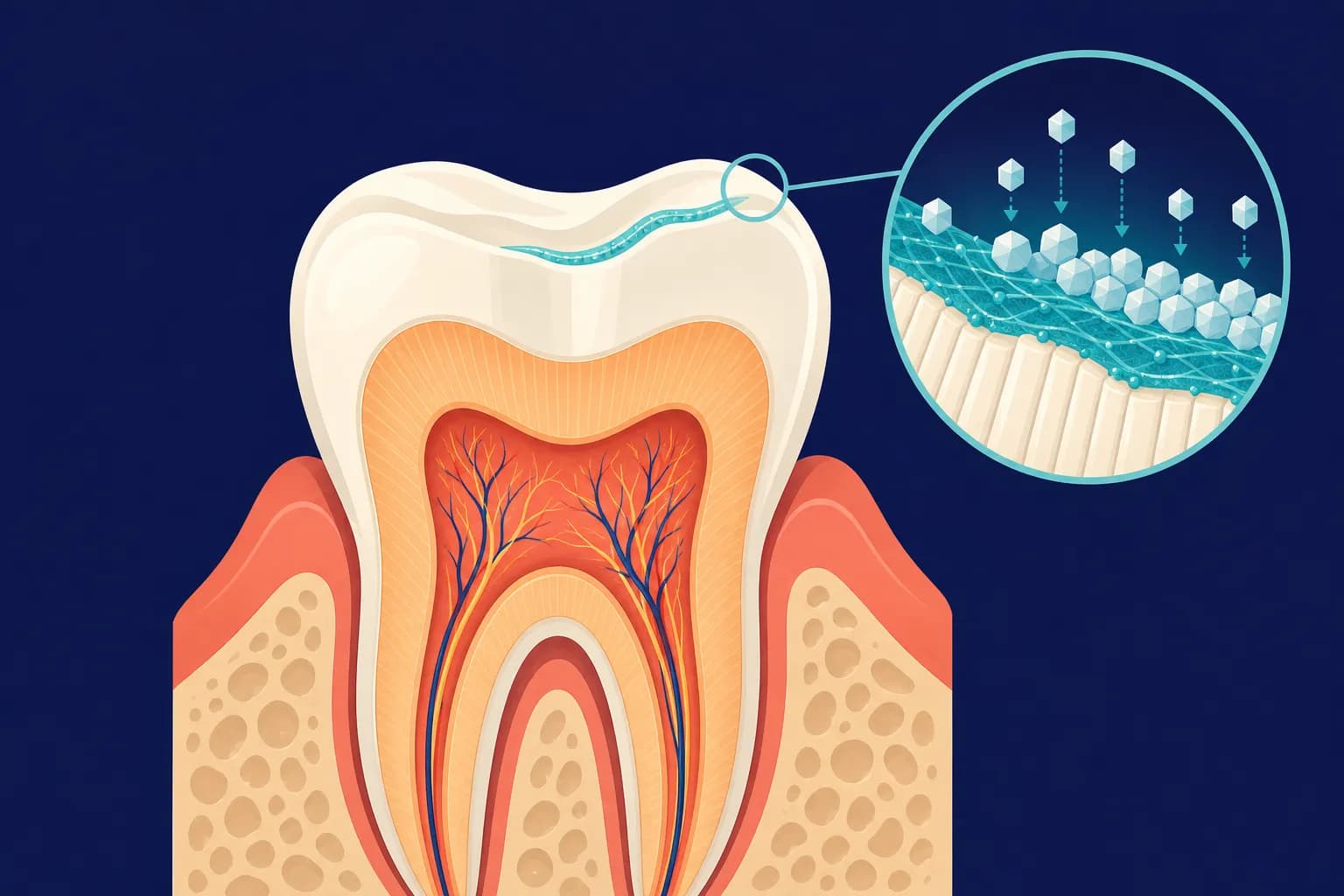
Enamel consists mainly of mineral crystals. Its strength depends on both its composition and the way these crystals are organized. During tooth development, a protein matrix guides their formation. Mature enamel has no cells capable of rebuilding a lost area.
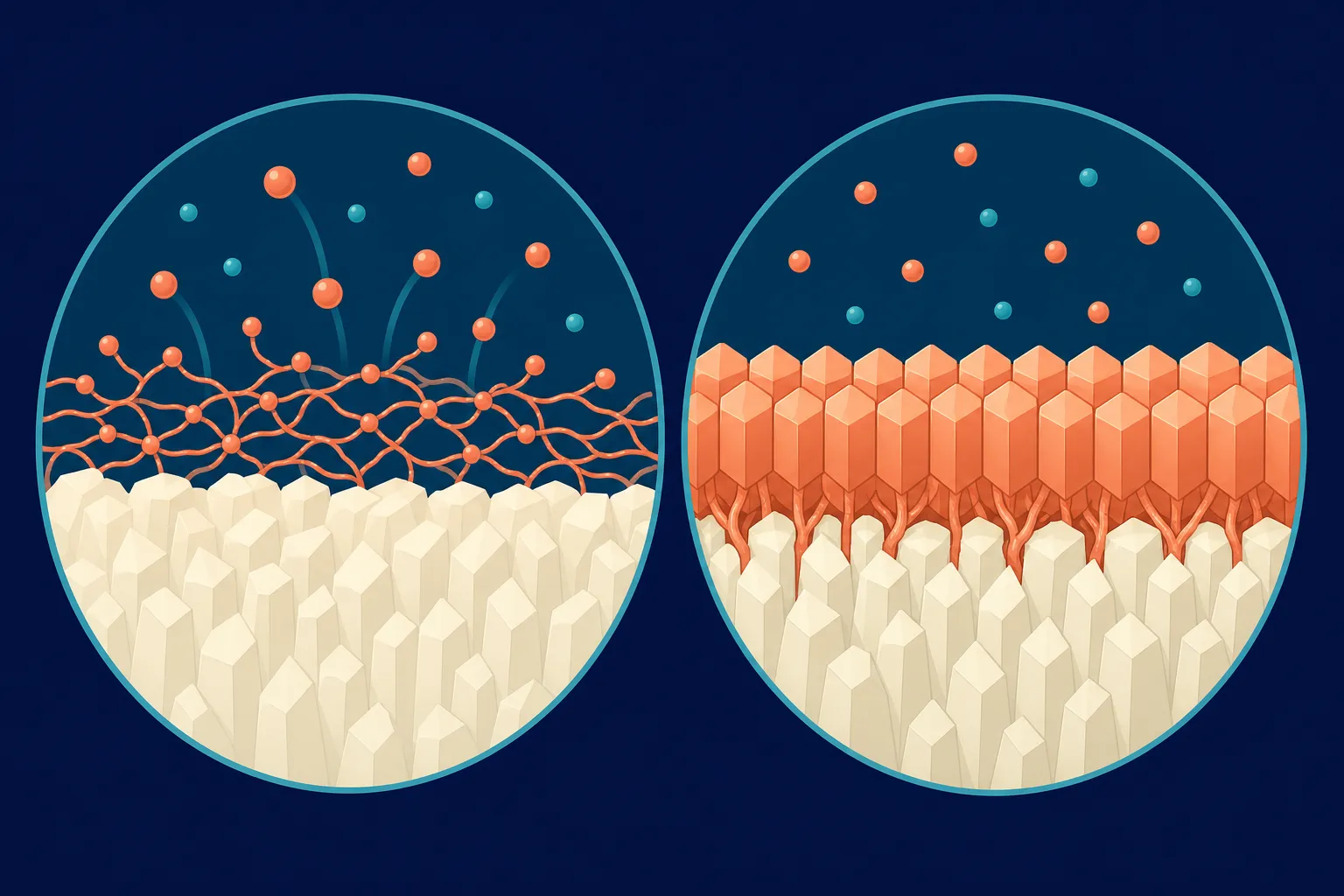
The researchers tried to reproduce some of the functions of this matrix.
The gel is based on elastin-like recombinamers, or ELRs: artificially engineered protein molecules.
They form a scaffold that guides the growth of mineral crystals and helps them bond with tooth tissue.
Saliva acts as a source of calcium and phosphate ions, the building blocks for mineralization. The gel’s role is to organize their deposition on the damaged surface. Rather than simply applying a coating made of a ready-made substance, the mineral layer forms directly on the tooth.
It is this ability to guide crystal growth that makes the development interesting. The presence of calcium and phosphate alone is not enough to automatically produce a material with the structure and properties of enamel.
Conceptual diagram: a protein matrix guides mineralization on the tooth surface. Layer thickness is illustrative.
What kind of layer was grown in the laboratory
In experiments on extracted human teeth, the authors produced mineralized layers up to 10 micrometers thick, or one hundredth of a millimeter. This is a thin surface repair. The study does not show that this method can restore the full volume of enamel lost through significant wear or fill a large defect.
The team also tested mineralization in natural human saliva. They used samples from three healthy donors, and the process lasted two weeks. So applying the gel quickly should not be confused with instant repair: forming a mineralized layer takes time.
The authors assessed the material’s structure and mechanical properties, including hardness and Young’s modulus. Hardness describes resistance to localized indentation, while Young’s modulus indicates how strongly a material resists elastic deformation. After mineralization in saliva, these measures were close to those of healthy enamel.
This is a meaningful result: the researchers produced a layer that resembles enamel in more than just its mineral composition. But these measurements do not yet show how many years it can withstand chewing, brushing, and exposure to acids in the mouth.
How surface repair differs from remineralization
Saliva helps maintain the mineral balance of teeth even without the experimental gel. If enamel has partially lost minerals but its structure remains intact, some of that loss can be replenished. This is the basis of remineralization for early lesions.
Erosion or mechanical wear is different: tissue may be physically lost, changing the tooth’s surface. In this case, the possibility of adding a new mineral layer and bonding it to the remaining tissue is of interest. This is the problem the laboratory development aims to address.
In this context, the term “tooth enamel regeneration” should be understood as growing an enamel-like material. Natural tooth development does not start again. Nor is there reason to consider the gel a proven replacement for fillings or other ways of repairing large defects.
For people with enamel wear and sensitivity, this technology could potentially help restore some of the protective surface. However, the study did not test whether it reduces sensitivity in patients.
What is known about the human trial
The development has reached its next stage. The UK Health Research Authority website has published a description of the Epinamel pilot study, which received a positive ethics committee opinion on January 14, 2026. The sponsor is Mintech-Bio Ltd. Two authors of the laboratory study reported that they are company co-founders and hold shares in it.
The plan calls for around 20 participants aged 12–60 with white spots after braces. Epinamel is intended to be compared with Curodont Repair on different sides of each participant’s mouth.
This study addresses a different, though related, problem. White spots are associated with changes in enamel mineralization; treating them is not the same as repairing a surface lost through erosion or wear. In addition, the published description outlines the trial plan, not its results. A positive ethics opinion allows the study to proceed, but does not in itself confirm the material’s effectiveness.
What the development could mean for patients
The technology’s promise lies in the possibility of restoring a thin protective layer where natural enamel has already been lost. It must be confirmed that the material bonds reliably to the tooth, lasts in the mouth, and provides a meaningful benefit to people.
If you have sensitivity or noticeable enamel wear, it is already worth discussing with a dentist what caused the tissue loss and how to preserve the remaining surface. Acid erosion and mechanical wear call for different approaches. Even if a new mineral layer can be successfully grown in patients, the causes of the original enamel damage will still need to be addressed.
Can I buy this gel for home use?
The development’s commercial availability has not been confirmed in verified editorial sources. An expected product launch date is not the same as a product reaching the market, and ordinary products that promise to “repair enamel” cannot automatically be considered equivalents of the experimental gel.
Will the gel work if I have dry mouth?
It is not yet known. Mineralization in natural saliva was tested using samples from just three healthy donors. These results cannot automatically be applied to people with reduced saliva production or a different saliva composition.
Can this technology be called completely fluoride-free?
No, that conclusion would be premature. The gel itself is described as fluoride-free, but some of the experimental mineralizing solutions contained fluoride. Therefore, not all the study’s results can be attributed to a process that is entirely independent of fluoride.