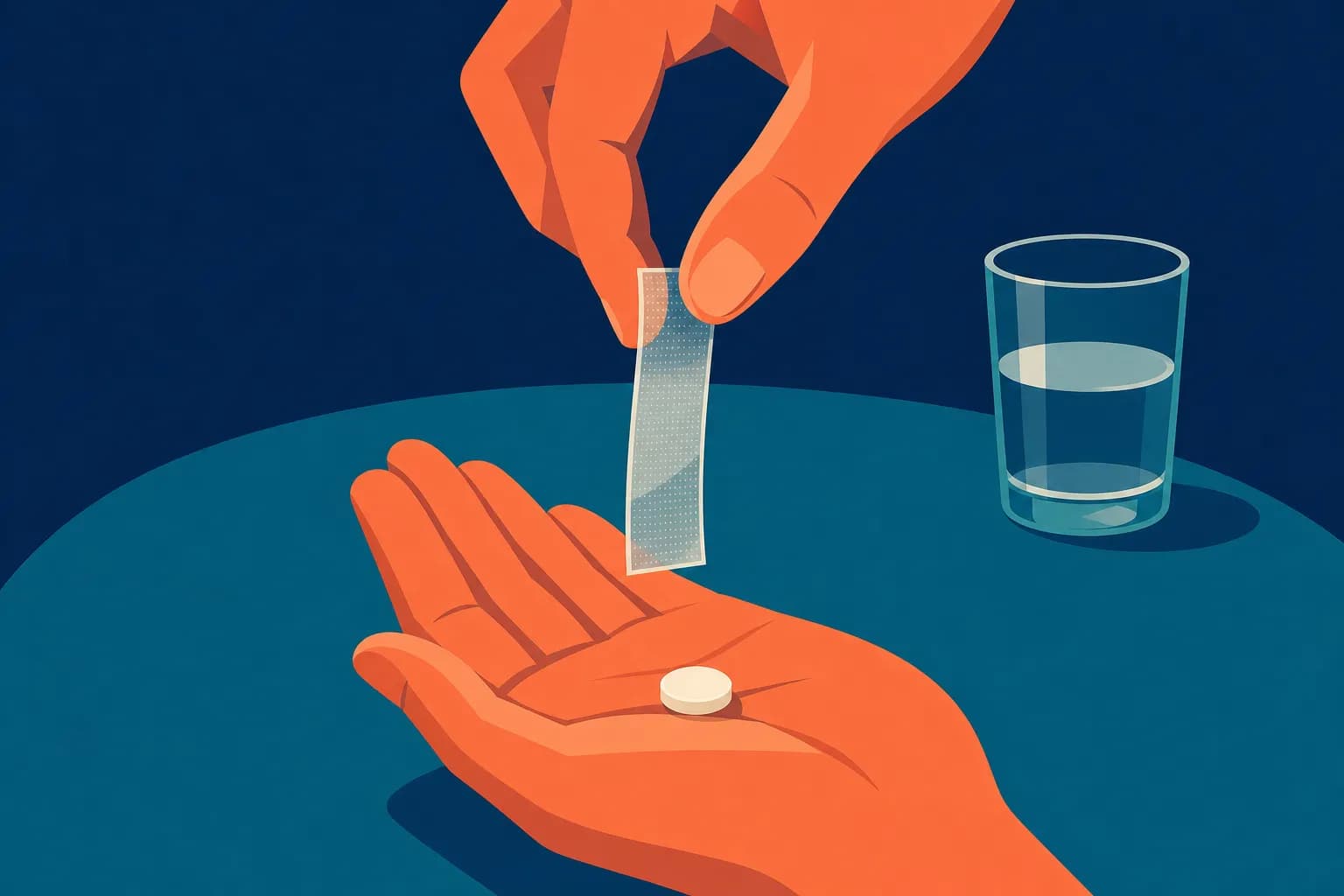
A thin strip dissolves on the tongue, eliminating the need to swallow a tablet or find water. This makes taking supplements convenient. But a film disappearing quickly in the mouth does not in itself mean that vitamins are absorbed better. Any advantage needs to be assessed separately for each ingredient, formulation, and dose.
On October 21, 2026, the Global Wellness Summit highlighted supplement strips as a consumer trend. The format is drawing attention as an alternative to tablets and gummy supplements. However, this news reflects consumer interest, not the emergence of new evidence that strips are superior.
What happens when a strip dissolves in your mouth
Dissolvable strips, or orodispersible films, contain an active ingredient in a thin base that breaks down when it comes into contact with saliva. From there, the ingredient can be delivered in different ways.
As explained in a review published in Pharmaceutics in December 2023, most such films form a solution or suspension in the mouth. The person swallows the contents with their saliva, after which the ingredient is absorbed in the gastrointestinal tract. In this case, rapid dissolving makes the supplement easier to take, but does not prove that it enters the bloodstream through the oral mucosa.
Some formulations are indeed designed for absorption under the tongue or through the lining of the cheek. This route depends on the properties of the molecule, including its size, solubility, and ability to pass through cell membranes. These limitations are described in a review in Discover Pharmaceutical Sciences.
That is why the film's disintegration, the ingredient's absorption, its bioavailability, and its effects on health should be assessed separately. A strip may disappear in a short time, but that tells us nothing about what proportion of the dose reaches the bloodstream or whether it will provide the expected benefit.
What we know about the absorption of vitamins D3 and B12
One example of a human study looked at vitamin D3. In a study published in Clinical Drug Investigation in January 2022, 48 healthy volunteers took a single 25,000 IU dose of vitamin D3: as a film after a meal or on an empty stomach, or as a solution after a meal. This dose was part of the research protocol and is not a recommendation for routine self-administration.
The pharmacokinetic profiles–that is, how the concentration of the substance in the blood changed over time–were broadly similar. The authors described the bioavailability of the film taken after a meal as slightly higher than that of the solution, but found no statistically significant differences between the groups.
The study shows that a particular film can deliver vitamin D3 into the body. But it does not establish an advantage over tablets: tablets were not included in the study. In addition, the trial was small and open-label, and assessed a single dose without measuring long-term health outcomes. It was funded by the film's manufacturer, IBSA; most of the authors worked for companies within the group.
For vitamin B12, there is another useful reference point. The NIH Office of Dietary Supplements fact sheet, updated in July 2025, states that available evidence does not show differences in the effectiveness of standard oral and sublingual forms of B12. This is not a trial of all modern strips, but there is also no basis for assuming that placing a supplement under the tongue automatically gives it an advantage.
Why dose matters more than package size
A thin film can hold only a limited amount of an ingredient. According to a review published in Food Production, Processing and Nutrition in January 2025, increasing the amount of active ingredient can make a film more fragile and reduce its stability. Manufacturers have to find a balance between the dose and the material's properties.
This does not mean that every strip contains too little vitamin. A suitable dose may be small for one ingredient, while another may require considerably more space. Check the amount of each ingredient per strip and per serving.
If a serving consists of several strips, comparing one strip with one tablet can be misleading. For the same reason, the number of units in a package says little about its cost: it is more useful to compare the price of an equivalent daily dose.
What is the real advantage of strips?
Convenience has practical value. You can take a strip without water, and this format may suit someone who finds it unpleasant to swallow large tablets. In the vitamin D3 study, participants generally rated using the film as easy or very easy. We have previously looked at taking different forms of D2 and D3.
If a convenient format helps you stick to an otherwise well-founded supplement routine, that is a reasonable argument in its favor. However, convenience does not make a supplement necessary or enhance the effects of the ingredient it contains.
Preferences also vary: some people may like the taste and feel of a film in the mouth, while others may find them off-putting. There is no universally best format.
What to check before buying vitamins in strips
It is useful to assess a product using the same criteria as any other supplement:
Amount of active ingredient. Check the dose in one strip and the number of strips per serving. Take into account the same vitamin in any other products you use.
Evidence for the claimed advantage. The study should relate to the specific formulation. If a manufacturer claims better absorption than a tablet, this needs to be tested at comparable doses.
What the result means. Rapid dissolving, earlier appearance of the ingredient in the blood, and improved health outcomes answer different questions.
Full ingredient list and cost per serving. Flavorings, sweeteners, and other inactive ingredients may also influence your choice.
A strip may justify its price through convenience. To justify paying extra specifically for “better absorption,” comparative data on the product being sold are needed. Without such data, the advantage remains unproven, although the supplement itself may still do what it is intended to do.
Do I have to hold the strip under my tongue?
No, how to use it depends on the specific product. Follow the instructions: a film intended to dissolve on the tongue and then be swallowed has not been proven more effective just because it is placed under the tongue.
Can I replace a prescribed medication with vitamins in strips?
You should not replace a prescribed medication with a supplement on your own. Having the same vitamin name does not guarantee a matching dose, formulation, or evidence of effectiveness. Discuss any switch with a doctor or pharmacist, especially if the medication was prescribed to treat a deficiency.
Does being sold in the US mean that the FDA has verified the effectiveness of strips?
No, the mere fact that a dietary supplement is sold does not mean that. According to information from the FDA, the agency does not approve dietary supplements for safety and effectiveness before they reach the US market. This rule also applies to supplements in strip form.