“I Don’t Remember That”: Why Memories of Childhood Differ
Published on: ⋄8 min read
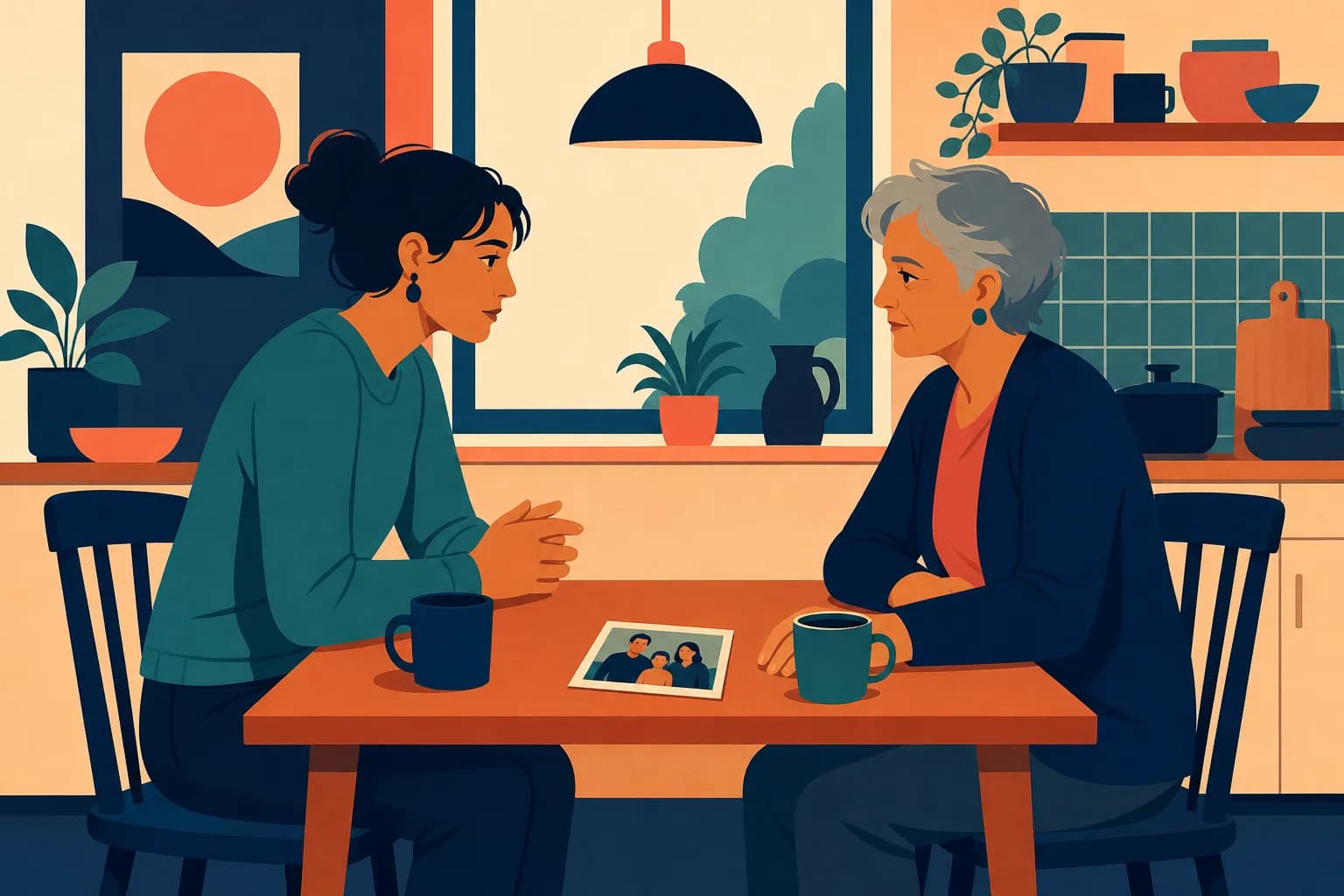
An adult child recalls a humiliating joke at the family dinner table. Their parent replies, “I don’t remember that.” A conversation that was supposed to bring relief turns into an argument about whether there was even anything to be upset about. But one person’s lack of memory does not, by itself, mean the event never happened.
You don’t need your parent to confirm what happened in order to acknowledge your own pain and seek support. At the same time, taking your feelings seriously doesn’t mean treating every detail of a memory as an established fact. You can care for yourself while allowing some uncertainty about the past.
Why parents and children remember the same event differently
Memory is selective from the moment an event happens. People notice different details, assign them different meanings, and connect them to different past experiences. Later, new knowledge, family conversations, and changing views of relationships can shape how they tell the story.
In a review in the Journal of Child Psychology and Psychiatry, the authors identify three groups of possible reasons for discrepancies in reports of maltreatment: measurement methods, memory processes, and willingness to disclose what happened. Even the wording of a question matters: “Were you ever humiliated?” and “Were you ever mocked in front of other people?” may elicit different answers.
There is also a difference in the participants’ positions. In an essay for Mindful, Juliana Sloan suggests taking into account a child’s dependence on an adult. A parent may see a sharp remark as one of dozens of everyday incidents. For a child, it may signal a threat to closeness, acceptance, or safety. This is an interpretive framework for understanding the situation, not the result of new memory research.
The asymmetry in memories of causing harm has also been studied experimentally. In a series of five studies, participants generally found it easier to recall times when they had been hurt than times when they had hurt someone else. The authors linked these differences to emotional experiences and perceptions of intent. However, these experiments did not specifically examine parents’ and adult children’s memories.
So it’s possible for both people to be sincere: one remembers being hurt, while the other can’t bring the incident to mind. A defensive reaction, reluctance to discuss the past, or deliberate denial are also possible. You can’t determine the reason from one remark alone.
What research says about childhood memories
At first glance, scientific findings may seem contradictory: different sources of information about childhood often disagree, yet people’s own accounts can remain fairly stable. In fact, they address different questions.
A 2019 meta-analysis in JAMA Psychiatry combined 16 studies involving more than 25,000 people. Researchers found little agreement between assessments of maltreatment made during childhood and retrospective reports collected years later. These methods identified largely different groups of people. Official records may have missed cases that were never reported, or may have reflected primarily the most severe situations.
This was not a comparison of parents’ and children’s memories. Nor does the finding allow us to declare one method of gathering information categorically correct and the other mistaken.
The authors of a 2026 meta-analysis in Nature Mental Health asked a different question: how much do retrospective self-reports change when people are interviewed again? Across 49 studies involving more than 38,000 people, they found that these reports were highly consistent, with an average interval of about two and a half years between interviews.
Both findings can be true: a person may consistently describe what they experienced even if external sources do not confirm it.
But consistency does not verify every date or remark. In addition, these studies focus primarily on abuse and neglect; their findings should be applied cautiously to other kinds of family hurt.
How forgetting differs from invalidation and gaslighting
The phrase “I don’t remember that” tells you about the speaker’s memory. What happens next shows whether they’re willing to respect your experience.
“I don’t remember that conversation, but I hear that it hurt you” leaves room for two perspectives. “If I don’t remember it, you must have made it up” turns a lack of memory into an accusation. And “Even if it happened, normal children don’t get upset about things like that” invalidates your experience regardless of how well the person remembers the event.
Gaslighting, too, can’t be identified based on a single remark. In an explanation from Cleveland Clinic, psychologist Chivonna Childs describes it as a recurring pattern of manipulation. In this context, a person is systematically pushed to doubt their own perceptions and ability to judge what is happening.
Repetition matters: Are all uncomfortable events denied? Is disagreement accompanied by humiliation? Is your supposed “unreliable” memory used to control your present-day decisions? Even this context does not allow an outside observer to determine with certainty what a person intended in a particular conversation.
At the same time, you don’t have to prove that it’s gaslighting before you can refuse to continue a conversation that includes insults. You can set a boundary based on what is happening now: “I’m willing to talk about our different memories. You can’t speak to me in that tone.”
Do you need your parent to acknowledge what happened in order to trust your own pain?
It’s understandable to want to hear, “Yes, I did that.” Acknowledgment can restore a sense of fairness and show that someone close to you finally understands the impact of their actions. But if only your parent has the authority to confirm your pain, caring for yourself becomes dependent on their memory and willingness to talk.
It can help to separate three things:
What you remember: “I remember being mocked for crying.”
How you experienced it: “I felt ashamed to ask for comfort.”
What you need now: “I want my feelings to be discussed without mockery.”
These statements have different status. The details in the first may remain disputed. The second describes your experience. The third sets a condition for your relationship now.
Pain alone does not prove that a specific event happened. But it is enough reason to take your own well-being seriously. You can acknowledge: “I can’t verify every circumstance, but this experience still affects me.” That’s an honest position that makes room for both self-respect and uncertainty.
Before the conversation, it can help to clarify separately what you remember, how you experienced it, and what you’re asking for now.
How to talk to a parent about a painful incident
First, decide what you want from the conversation: to explain the impact, receive an apology, hear another version, or agree on how to behave now. These goals are connected, but achieving one doesn’t guarantee the others. A parent may acknowledge your pain without remembering the incident.
Choose one specific incident. Instead of “You always humiliated me,” try: “I want to talk about that conversation after the school meeting.” It’s easier to stay focused on one incident than on the entire history of your relationship.
Be clear about what you’re sure of. “I don’t remember the exact words, but this is what they meant to me.” You don’t need to add exact quotes or details just to sound convincing.
Describe the impact without demanding immediate agreement with your entire version. “After that, it became hard for me to tell you about my mistakes. I want to explain why.”
Make a doable request. For example: “Please hear me out before responding,” or “Don’t call my feelings made up, even if you remember things differently.”
If they reply, “I don’t remember,” you can say: “I understand that you may not remember it. It matters to me that we can talk about how I experienced it.” This is an invitation to talk, not a way to guarantee acknowledgment.
What to do if your parent continues to deny it
Different memories can sometimes bring a conversation to a dead end: each new argument prompts a counterargument. At that point, it may help to consider whether the conversation is meeting your goal. If you wanted to be heard but find yourself having to prove that you’re entitled to your feelings again, continuing the argument may not help.
You can call for a pause: “We’re going over the same things now. I’m going to end the conversation and come back to it if we can talk without accusations.” Taking a pause doesn’t require making a final decision about the relationship.
It’s best to tie boundaries to observable behavior. For example: “If you start making fun of me, I’ll end the call.” That’s clearer and more doable than demanding, “Admit everything that happened in the past before we can have a relationship.”
Contact can take different forms: regular interaction without discussing this topic, less frequent visits, or some distance for a while. There’s no universally right option. What matters is your present safety, whether you depend on the family member, the options available to you, and how the contact affects your well-being.
If you want to preserve your own account, you can write it down, distinguishing clearly remembered details from assumptions and information you heard from others. This can help you organize your experience, but it doesn’t serve as independent confirmation that the event happened. Discussing it repeatedly does not, by itself, guarantee greater accuracy either.
How psychotherapy can help
You don’t need your parent’s acknowledgment or a “case file” about your childhood to see a psychologist or psychotherapist. You can seek help for effects that are interfering with your life now:prolonged anxiety after contact with family, sleep difficulties, constant mental arguments, or fear of expressing disagreement.
Therapy may address shame, anger, loss of trust, ways of communicating, and setting boundaries. At the same time, a therapist’s office should not become a place where the historical accuracy of every incident is determined by the intensity of someone’s emotions. Listening with care while remaining cautious about conclusions regarding the past are entirely compatible.
A joint family session can sometimes make it possible to discuss different accounts, if everyone agrees and can talk without intimidation. If there are threats or ongoing abuse, safety comes first, and taking part in a joint conversation is not an obligation.
You may never arrive at a shared version of the past. In that case, the task at hand is to define the conditions for the present: what you’re willing to talk about, what kind of treatment you won’t accept, and what support you can access regardless of your parent’s response.
Can siblings remember the same parents differently?
Yes. Children in the same family can have different experiences and memories. They were present for different conversations, were different ages, and their parents may have treated them differently. A sibling saying, “That never happened to me,” describes their experience and does not, by itself, disprove yours.
What if I remember the meaning but not the exact words?
Share the meaning and state plainly that your recollection of the wording is approximate. For example: “I can’t quote you word for word, but I remember taking your words as mockery.” Uncertainty about the exact remark doesn’t mean you have to avoid the conversation or fill in the gaps with assumptions.
Should I try to recover forgotten incidents through hypnosis?
Don’t use hypnosis or leading questions as a way to establish exactly what happened. A systematic review by Chris Brewin and Bernice Andrews describes how suggestion in experimental settings can produce false autobiographical memories in some participants. This is not a reason to declare a specific memory false, but it is a reason to be cautious about methods that promise to recover the past.
Why does it still hurt after my parent apologizes?
An apology doesn’t have to immediately change your feelings, trust, or habitual reactions. It may be an important step, while you still need time, support, and experiences of being treated differently. Accepting an apology, forgiving someone, and restoring the closeness you once had can be considered separate decisions.