How Much Fiber Does the Gut Need to Produce Butyrate?
Gut bacteria produce butyrate when they receive the right types of fiber. We explain where to start, which foods to choose, and how to avoid bloating.

⋄8 min read
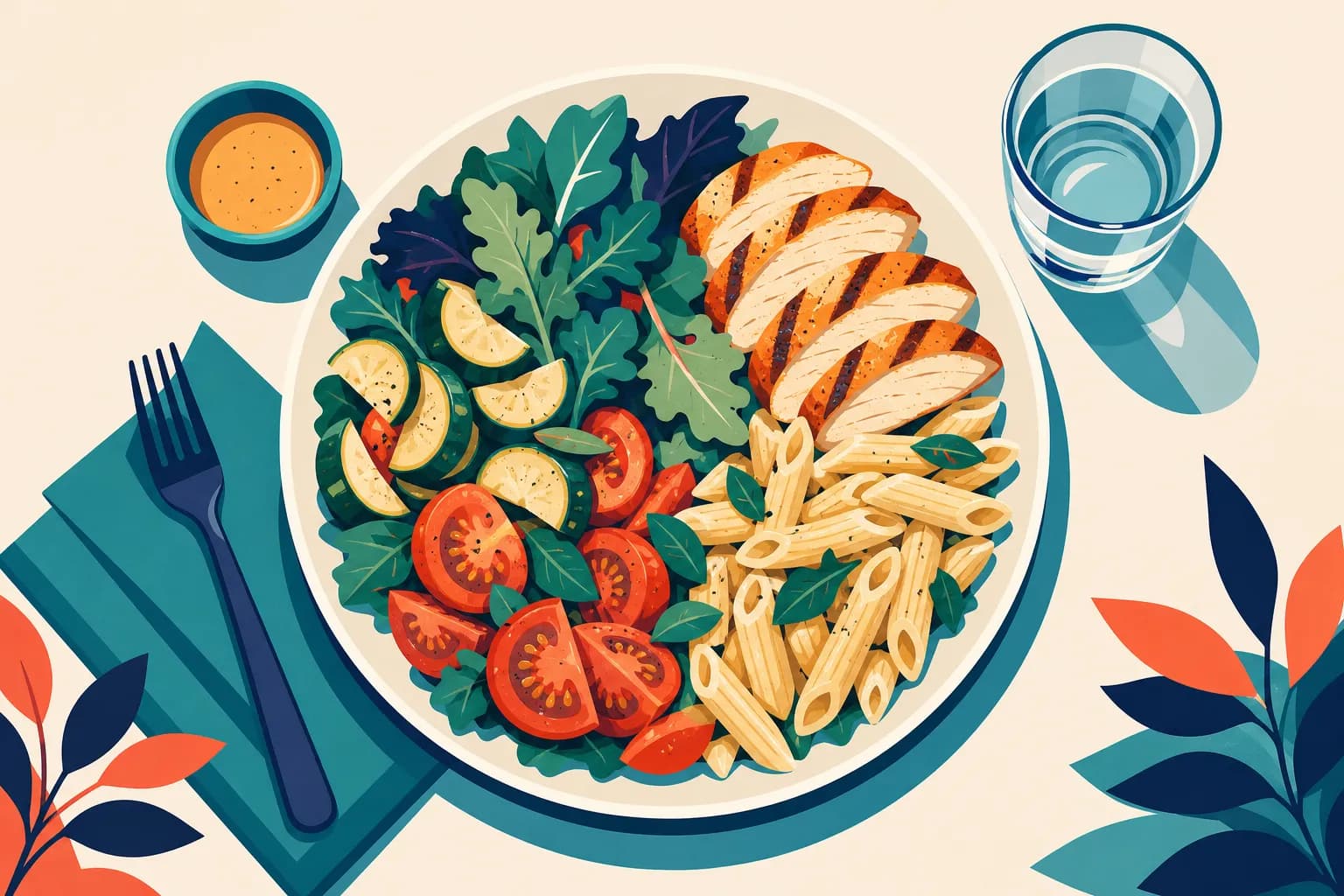
A large plate of food may help with weight loss if a substantial part of it consists of foods that are low in calories per gram. In experiments, this approach did reduce calorie intake, and in one year-long study, participants lost weight and felt less hungry. This is the principle behind volume eating, which is now being widely discussed on TikTok.
The promise of losing weight without feeling hungry at all goes beyond what these findings show. Thousands of videos about volume eating are going viral on TikTok, but the principle itself has been studied for a long time. The news angle here is the attention the approach is getting on social media, not a new clinical discovery.
The approach is based on reducing the energy density of your diet, or the number of calories per gram of food. Water adds weight to food without adding calories. That’s why vegetables, many fruits, and some soups allow you to eat a larger portion with relatively few calories.
For example, replacing some of the pasta in a dish with zucchini and tomatoes can keep the portion size the same while reducing its calorie content. Simply adding vegetables to your usual serving of pasta, cheese, and sauce would have a different result: there would be more food, but its total calorie content would not decrease.
Stomach stretching plays a role in sending fullness signals. However, feeling full immediately after eating and staying satisfied for a long time are two different things. The composition and texture of food also affect when hunger returns. So the size of your plate alone tells you little about how satisfying a meal will be.
One study that directly tested this principle was conducted by Julia Ello-Martin and her colleagues. In a year-long randomized trial published in the American Journal of Clinical Nutrition in 2007, 97 women with obesity took part. One group was advised to reduce their fat intake, while the other was additionally encouraged to eat more water-rich foods.
Among the 71 participants who completed the study, average weight loss was 7.9 kg in the second group and 6.4 kg in the first. Women who increased their intake of water-rich foods also reported feeling less hungry.
This supports the idea that you can reduce calories without necessarily reducing the weight of your food. But the results from a small group of women with obesity cannot be treated as a prediction for everyone. Also, feeling less hungry on average does not mean feeling no hunger at all. The study tested a specific eating program, not all the recipes now being posted under the name volume eating.
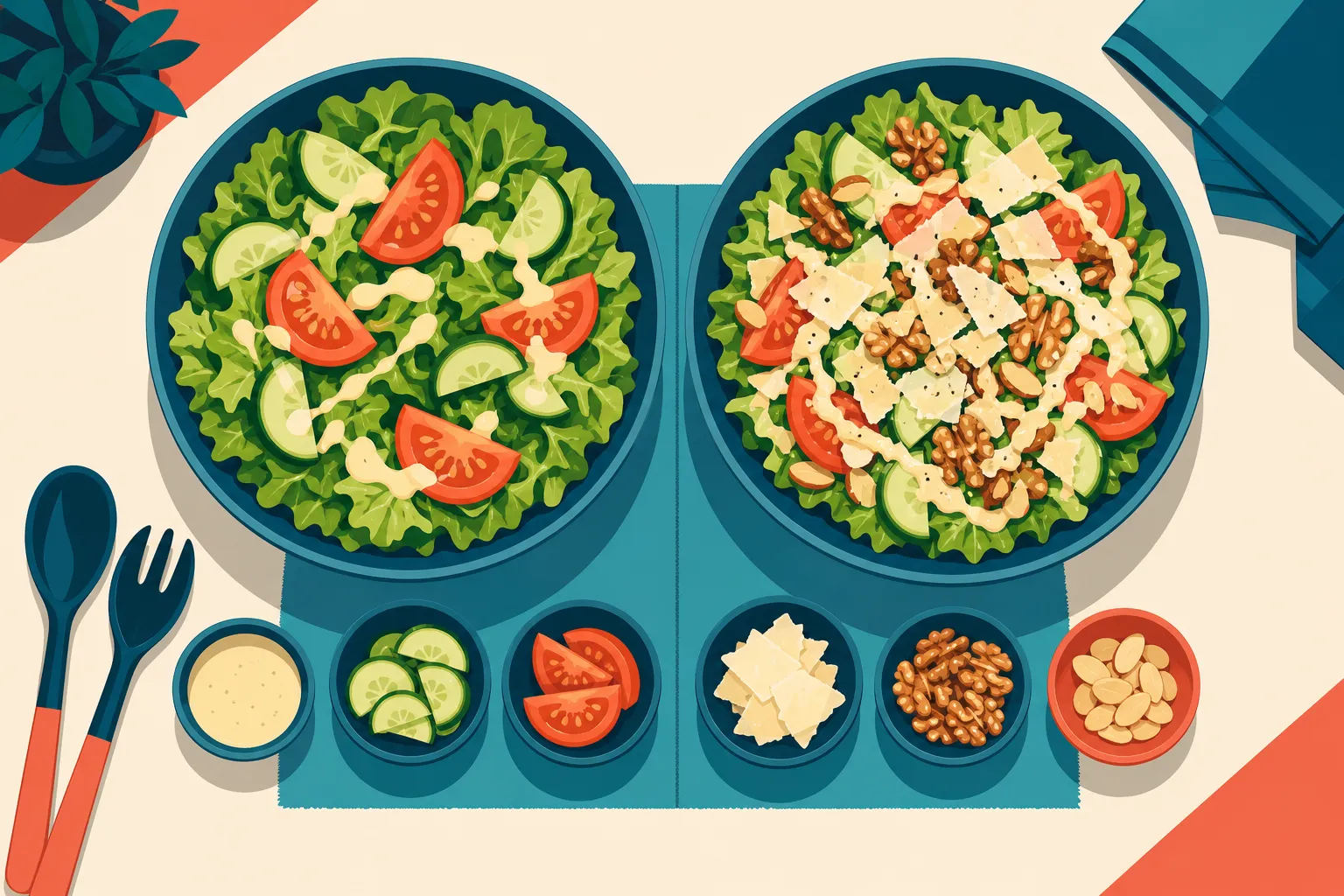
The role of a dish’s composition is clearly illustrated by experiments by Barbara Rolls and her colleagues, involving 42 women. Before serving pasta, they offered salads of different sizes and energy densities, which they varied by changing the dressing and cheese.
A 300 g portion of low-calorie salad reduced the total calorie content of lunch, including the salad itself, by 12% compared with a lunch without salad. A larger portion of higher-calorie salad, by contrast, increased it by 17%.
Both options looked like a large serving of vegetables. What made the difference was how much energy each gram contained. Cheese, oil, and nuts can all be part of a balanced diet, but even a small amount can significantly change a dish’s calorie content. Leafy greens and cucumbers don’t cancel out those calories.
Even the same weight and calorie content don’t guarantee the same effect. A study involving 58 adults compared a whole apple, applesauce, and juice. The servings were matched for weight, calorie content, energy density, and speed of consumption. A whole apple produced a stronger feeling of fullness than applesauce or juice. Eaten before a main course, it also reduced the total calorie content of lunch by about 15% compared with having no snack beforehand.
It also matters how water is incorporated into a dish. For example, chicken-and-rice soup increases fullness and reduces subsequent energy intake more than a casserole made with the same ingredients, with an equivalent amount of water served separately.
Fiber is not a universal guarantee of fullness either. A 2025 systematic review in Nutrition Reviews, which included 48 studies of cereal fiber, found that fiber generally improved subjective measures of fullness but had a limited effect on subsequent calorie intake.
These findings help distinguish three questions: how full a person feels, how much they eat later, and whether their weight changes over the course of months. Answering the first question does not answer the others.
The practical idea is to replace some energy-dense ingredients with less energy-dense ones. There’s no need to make every portion as large as possible.
Replace part of a familiar dish. For example, add vegetables in place of some of the pasta while keeping a source of protein and an amount of sauce that works for you. This makes it easier to lower energy density without sharply reducing the weight of your food.
Consider the composition of the whole plate. A large bowl of greens doesn’t become a complete lunch just because of its volume. Include sources of protein, carbohydrates, and fats, and consider the rest of your diet. Adding protein alone doesn’t guarantee that you won’t feel hungry.
Pay attention to what happens after you eat. If your stomach feels overfull but you’re hungry again soon afterward, adding more vegetables to your portion may not solve the problem. The meal may have been too low in energy or unbalanced in its composition.
Increase your fiber intake gradually. A sudden change in your diet can cause bloating and discomfort.
A good substitution can preserve the pleasure of a satisfying, generous portion while lowering its calorie content. But if getting more volume means enduring an overfull stomach or regularly going hungry, portion size is no longer a useful guide.
How was this article?
Share