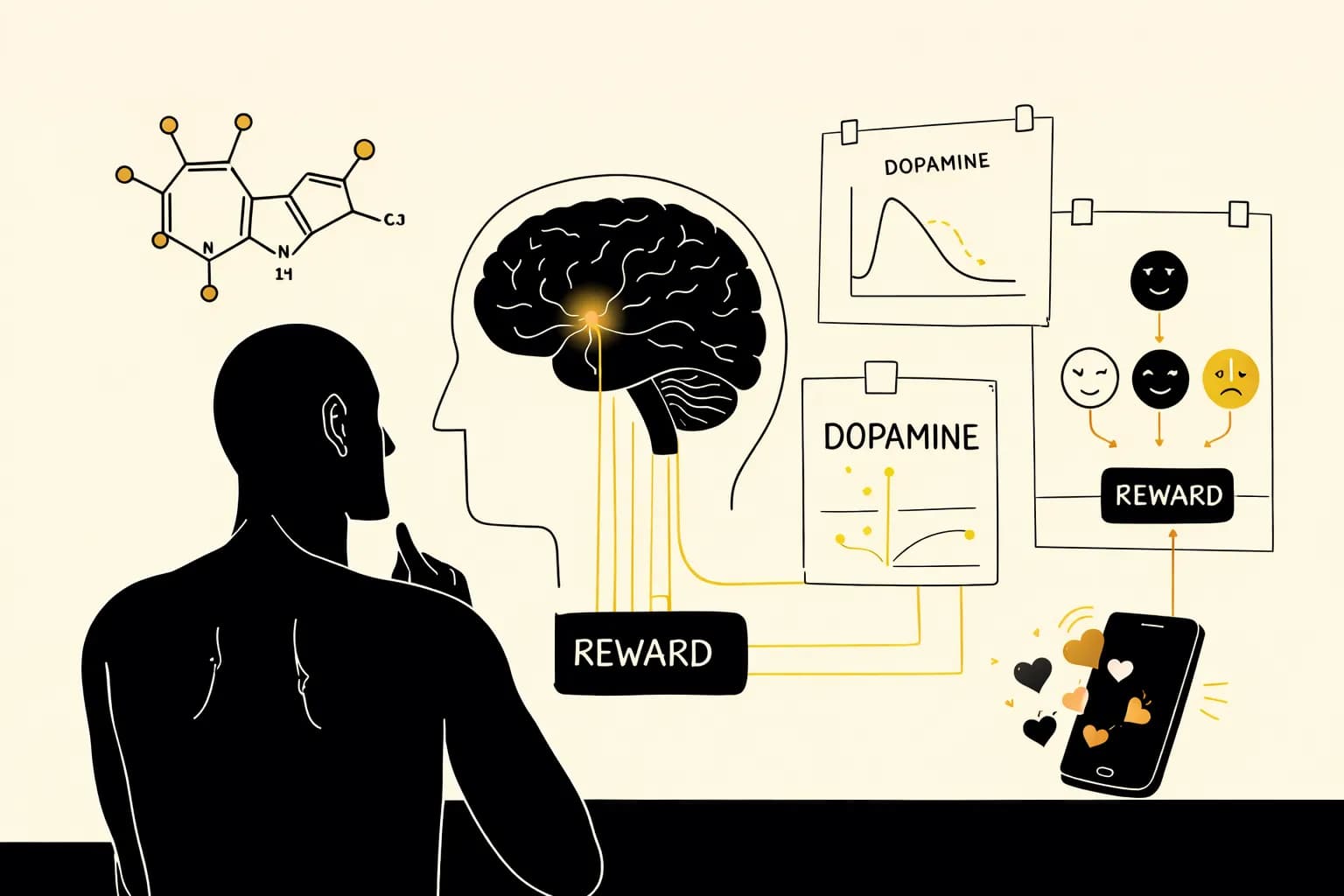
Imagining yourself in a new job, running a successful business, or having your ideal figure is much more pleasant than going to interviews, launching a project, or exercising regularly. In your imagination, the goal has already been achieved: you feel satisfied, confident, and happy with the result. But why can it sometimes feel even harder to take action after visualizing it?
From a neurophysiological perspective, imagination and real-life experience partially engage the same neural networks. That is why mental images can trigger genuine emotional and physiological responses. However, this does not mean the brain completely stops distinguishing fantasy from reality. Rather, vividly imagining a desired outcome can provide some emotional satisfaction before a person has made any effort to achieve it.
At the same time, the brain constantly weighs the expected benefits of an action against its costs. Cognitive effort, uncertainty, and the need to overcome obstacles can make a task seem less appealing. If a pleasant fantasy has already created a feeling of success, motivation to take the difficult path toward it may sometimes be weaker. What we call self-sabotage is not always due to a lack of willpower–sometimes it results from the interplay of expectations, emotions, and how we assess the effort ahead.
Psychologists Heather Barry Kappes and Gabriele Oettingen found that participants in experiments showed lower physiological mobilization after imagining idealized success. Their research suggests that positive visualization can reduce readiness to act when a person mentally enjoys the outcome without taking into account the obstacles along the way.
However, not all visualization gets in the way of achieving goals. Mental rehearsal of specific actions and mental contrasting–the practice of comparing a desired future with real obstacles–can help prepare us to do a task.
We explore how the brain responds to imagined success, why pleasant fantasies can sometimes weaken motivation, and how to use visualization to support action rather than replace real steps.
How positive fantasies differ from expecting success
Two people may both confidently say, “I imagine getting this job.” One assesses their chances based on their experience and the job requirements. The other experiences a pleasant scene: meeting the team, receiving congratulations, getting their first paycheck. Psychologically, these are different processes.
Expecting success means making a subjective assessment of how likely it is. A positive fantasy lets you feel how pleasant the desired future will be. It does not have to be unrealistic. What sets it apart is that the effort, delays, and setbacks are left out of the picture.
In four studies by Oettingen and Doris Mayer, published in the Journal of Personality and Social Psychology in 2002, these processes predicted subsequent behavior differently. Higher expectations of success were associated with greater effort and better outcomes. Pleasant fantasies were associated with the opposite pattern. Follow-up measurements were taken weeks and months later; in one case, participants were observed for up to two years.
These were predictive associations: the researchers measured expectations and fantasies rather than randomly assigning people to one or the other. So the study alone does not establish that the fantasies caused people to make less effort.
Why a pleasant image of the future can reduce mobilization
Kappes and Oettingen tested this more directly in a series of four experiments published in the Journal of Experimental Social Psychology in 2011. The instructions encouraged participants to imagine an idealized future. Afterwards, their mobilization measures were lower than in the corresponding control conditions.
Mobilization was assessed in several ways, including systolic blood pressure and participants’ subjective sense of activation. Here, the word “energy” refers to readiness to make an effort. It does not refer to mystical energy sometimes mentioned in manifestation practices.
The authors proposed the following explanation: by mentally experiencing a desired outcome as already achieved, a person may temporarily feel less need to work toward it. Satisfaction is available now, even though the task is not yet complete. This is a proposed psychological mechanism. It does not support the popular claim that the brain literally cannot distinguish imagination from reality.
A drop in blood pressure does not, by itself, mean harm either: in these experiments, it was used as one measure of mobilization. Small experimental studies can help investigate a mechanism, but they do not allow us to conclude that every episode of daydreaming reduces everyday productivity.
Which kinds of visualization help you prepare to act
The word “visualization” covers several different instructions. That is why the advice to “imagine success more often” is too vague: the content of a mental scene can significantly change its function.
Type of imagining
What the focus is on
What it can be used for
Idealized fantasy
A pleasant outcome without significant difficulties
Experiencing the pleasure of a possible future
Mental rehearsal
Specific actions and the sequence for completing a task
Preparing for individual stages of a task
Mental contrasting
A desired future and the reality that stands in its way
Clarifying what is getting in the way of a goal and how achievable it is
A meta-analysis of mental simulation, published in Psychonomic Bulletin & Review in 2021, combined data from 5,685 participants and found an overall positive effect on behavior. This challenges the broad claim that “imagining success is harmful”: different ways of imagining lead to different outcomes.
However, the popular rule “always imagine the process instead of the outcome” cannot be considered definitively established either. The review authors found only five studies of process visualization that met their criteria. For now, there is not enough evidence to establish that one format is universally superior.
How mental contrasting works
Mental contrasting starts with a desired future. A person imagines what they want and what good it will bring, then turns to the present: what exactly is standing in the way of this outcome?
The order matters. If you start by listing difficulties endlessly, it is easy to lose sight of the value of the goal. If you stay only in the pleasant future, the obstacle may not enter your awareness at all. Contrasting connects these two parts: “I want this outcome, and to get there, I’ll have to deal with this.”
According to the theory of behavior, the response that follows depends on how achievable the goal seems. When the chances seem high enough, commitment to the goal may grow stronger. If they are low, a person may postpone or change the goal, or give it up. Sometimes giving up frees up resources for a more suitable task.
This distinguishes contrasting from the idea that you should “believe harder, no matter what.” A lack of money, time, an accessible environment, or support will not disappear through the intensity of an image. Examining obstacles should help you take limitations into account, not turn every setback into an accusation that you lack motivation. Financial instability can also affect thinking.
How effective is the method according to research?
A “if–then” plan is often added to mental contrasting: you choose an action in advance in response to a specific obstacle. This combination is known by the abbreviation MCII.
A 2021 meta-analysis in Frontiers in Psychology combined 21 studies with nearly 16,000 participants. On average, MCII produced a small to moderate improvement in goal attainment. This is an average difference between groups, not the probability of success for any one person. The authors also found signs of publication bias: the true average effect may be smaller than the published estimate.
More recent findings are also mixed. In two randomized trials published in 2026, an online version of MCII did not produce statistically significant benefits for increasing physical activity. The final samples included 59 students and 112 gym members.
Taken together, the findings suggest that the method can be viewed as an accessible self-regulation tool, with moderate expectations. Its results depend on the task, the conditions in which it is used, and how suitable the chosen plan is.
How to connect a desired outcome with a specific action
A practical version of this approach is known as WOOP. The official instructions lay out four consecutive steps: wish, outcome, obstacle, and plan.
Choose a wish. Pick a meaningful, feasible goal with a clear timeframe. For example: “Send two applications for suitable jobs by the end of the week.”
Imagine the best outcome. What will change once you’ve done it? You may feel that your job search has really begun. Give this image some attention, but don’t linger on it.
Identify the main internal obstacle. In WOOP, this step focuses on your own reaction or habit. For example: “Afraid of being judged, I keep tweaking the layout of a résumé that’s already finished.” Saying “I’m lazy” does not help you choose a response.
Make an “if–then” plan. For example: “If I feel like tweaking the layout again during the time I’ve set aside for applications, then I’ll open the job listing I chose and fill in the first section of the application.”
A good plan links a recognizable situation to an achievable action. “If things get hard, I’ll pull myself together” leaves the main question unanswered: what exactly should I do when I run into difficulty?
Consider internal obstacles alongside external conditions. If you lack a required qualification for an application, you may need to look for a different job or get training. A plan for overcoming procrastination will not solve this problem.
An “if–then” plan links a recognizable situation to a specific response–for example, putting your phone away and getting ready to go for a walk.
How to tell whether visualization is helping you
Evaluate it in terms of what you use it for. If the goal is to relax and have a pleasant experience, a fantasy may already be doing its job. Not every activity has to increase productivity.
If you use visualization of your wishes to pursue a goal, notice what happens afterwards. Does a specific next step emerge? When do you take it? Does the obstacle become clearer?
You can write down one observable result for the coming week: applications sent, tasks completed, a conversation that took place. Then compare what you planned with what actually happened. This record will not prove that the technique works, but it can help you notice whether the ritual is replacing the work itself.
If a plan has failed several times, it is more useful to reconsider the obstacle, the size of the task, or the support available than to demand an even more vivid image of success from yourself.
Do I need to give up my vision board?
No, having a vision board does not in itself mean you will take less action. It can remind you of your priorities. But findings on specific visualization exercises cannot automatically be applied to every collage; it can help to write down separately the actions that will bring you closer to your chosen goals.
Can manifestation change external events through imagination alone?
The studies mentioned here do not support this. They examine psychological self-regulation and human behavior. Changing your own attention or actions does not prove that you can mentally control other people’s decisions, chance events, or circumstances.
How many minutes should I spend visualizing?
There is no universally established, scientifically validated duration for every goal. For practical planning, it is more useful to finish the exercise with a clear action than to aim for a certain number of minutes or the most vivid image possible.
What if I can’t imagine a good future at all?
You do not have to force yourself to create vivid, joyful images: you can start by describing a small desired change in words. Difficulty anticipating pleasure can have various causes; one possible context is explored in the article on childhood trauma and the anticipation of pleasure. If a loss of interest and pleasure lasts for weeks and affects different areas of life, consider discussing it with a mental health professional.