The foundation of our results and decisions lies in motivation. This is our internal engine in achieving goals and our daily activities. But sometimes we feel that everything is in place: work, plans, ideas, the usual rhythm. Yet inside — there is no response. What used to ignite now requires effort. Projects are not inspiring, books do not captivate, exercise is postponed. And an inner voice appears: “I am lazy,” “I’m losing my grip,” “There is something wrong with me.”
Most often the issue is not character or willpower. The essence lies in how the brain’s dopamine system works and in what conditions it functions today. To restore motivation, first understand the mechanism itself, rather than trying to push yourself to work through pressure and willpower.
Dopamine is not the 'happiness hormone'
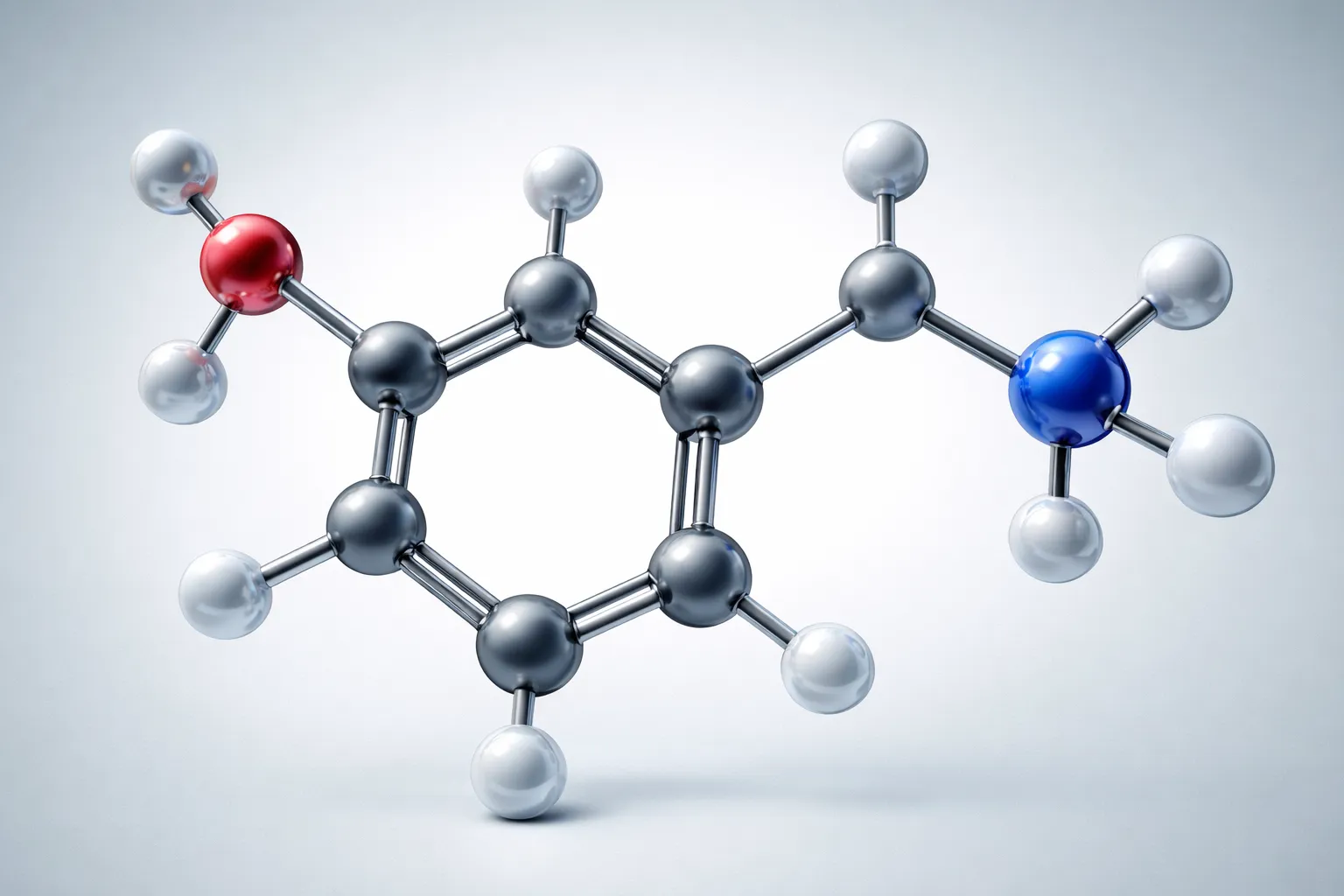
Dopamine is a neurotransmitter, a chemical substance through which neurons exchange signals. It is involved in regulating movement, attention, learning, as well as decision-making and motivation.
Dopamine molecule
The popular formula that dopamine equals pleasure is misleading. Pleasure is more closely related to the brain’s opioid system. Dopamine is responsible for something else — anticipation, significance, and striving.
It signals: “This is important. Move there.”
When you make plans, anticipate a meeting, start a new project, or feel excitement, it is the dopamine system that is activated. This is the chemistry of moving forward.
There are several dopamine pathways in the brain. The mesolimbic pathway is associated with learning through reward and the formation of motivation. The mesocortical pathway is involved in planning and controlling behavior. The nigrostriatal pathway regulates movement. These systems work together to create a sense of direction. When their balance is disrupted, it’s not “character” that suffers, but neurodynamics.
Anticipation of reward is more important than the reward itself
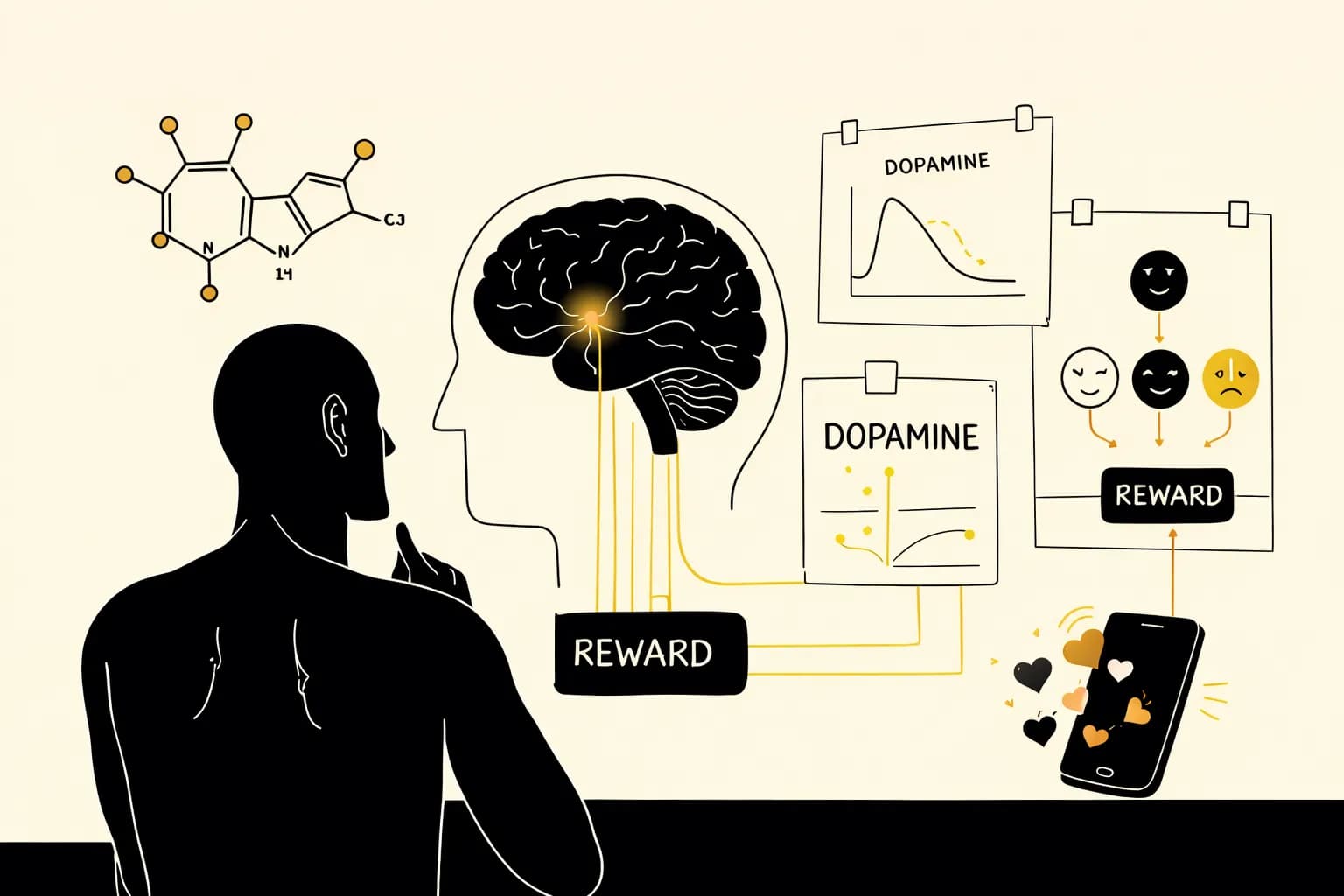
In the studies of neurobiologist Wolfram Schultz, it was shown that dopamine neurons are activated primarily at the moment of anticipating a reward, not at the moment of receiving it.
If the reward is expected, the dopamine peak occurs in advance. If it is unexpected — the spike occurs at the moment of receipt. If the expected reward does not come, the level drops below baseline. This phenomenon is called the “reward prediction error.”
The brain constantly compares forecast and reality. Dopamine encodes the difference between them.
Therefore anticipation is often more emotionally charged than the event itself. Planning can give more energy than execution. Scrolling social networks keeps attention not on a particular post, but on the endless anticipation of what comes next.
The dopamine system loves uncertainty. And the modern environment actively exploits this.
Overload of stimuli and decreased sensitivity
The brain was formed in conditions of stimulus scarcity. Novelty was rare. Rewards required time and effort. Today the situation is the opposite: an endless news feed, short videos, notifications, instant purchases, online games.
Each such stimulus triggers a dopamine surge. The problem is not the pleasure itself, but the frequency of peaks. With regular over-stimulation, receptors begin to lose sensitivity. This process is called downregulation.
The brain adapts to high-intensity signals. Baseline dopamine levels can decrease, and ordinary, “slower” pleasures begin to seem dull. A book seems boring, a long project — excessively heavy, training — an unjustified effort.
This is not a sign of weakness. It is an adaptation to the environment.
Why does motivation disappear?
Motivation arises when the expected reward subjectively exceeds the cost of effort. If the brain is used to instant gratification, tasks with delayed results become less attractive.
The reward system begins to favor a short cycle “stimulus — spike — next stimulus”. Long-term goals require a sustained dopamine background, not sharp peaks. When the background is lowered, effort feels disproportionate.
At this moment a person often increases self-criticism. However, stress further reduces cognitive control and heightens the craving for quick stimuli. A vicious circle emerges: low motivation — guilt — even lower energy.
How do social networks affect it?
Algorithms of digital platforms use the principle of variable reinforcement — unpredictable reward. The user does not know what stimulus they will receive next. This uncertainty enhances the dopamine response more than a guaranteed reward.
Every swipe is anticipation. Every notification is potential social significance. Social validation reinforces the signal. As a result, the brain stays in a mode of constant search.
A system designed for rare stimuli operates in a mode of continuous activation. This gradually changes the subjective sense of interest, depth, and meaning.
How to restore sensitivity?
Recovery does not require strict asceticism or a complete rejection of technology. Extreme measures often lead to regression. It is more important to change the dynamics.
Reducing the frequency of peaks helps receptors gradually restore sensitivity. This may mean limiting background stimulation and reducing the number of rapid shifts of attention.
Returning to actions with delayed reward — physical activity, learning, creative projects — strengthens the ability to endure effort. In the early stages such actions may seem less attractive. This is natural: the system needs time to recalibrate.
Supporting physiology plays a key role. Sleep, movement, daylight, and proper nutrition create conditions for stable neurochemistry. Without basic regulation, sustainable motivation is hard to expect.
Over time, pleasure becomes less sharp but more profound. The ability to concentrate and feel interest in the process returns.
Conclusions
Motivation — a signal from the neurobiological system. When it is overloaded, the impulse to act is noticeably reduced. This is not a defect, but a natural adaptation of the body to overload..
Dopamine directs our desires: it governs striving and anticipation, but not the pleasure of the process itself. When anticipation becomes weak or we overload the brain with fast stimuli, long-term goals lose their attractiveness for us.
The modern digital environment amplifies dopamine dynamics. Frequent peaks reduce receptor sensitivity and lower the baseline level of motivation.
Recovery is possible through calibration, not prohibition. Reducing stimulus density, returning to delayed rewards, and supporting physiology gradually restore sensitivity.
Letting go of guilt is part of the strategy. Self-criticism increases stress and further reduces motivation. Understanding the mechanism allows shifting from blame to regulation.
With hyperstimulation, the ability to manage attention and dopamine dynamics becomes a strategic skill that can be developed and applied in practice. Depth of concentration, resilience to distractions, and the ability to endure delayed gratification directly affect the quality of your life and your professional effectiveness.
Motivation does not disappear forever. It returns when the system once again operates in balance.