Sometimes life doesn't change because of one big decision. It changes because of actions so small that we hardly pay attention to them.
A glass of water in the morning. One page of a book before bed. Five minutes of movement instead of endlessly scrolling your phone.
In the moment it looks too simple to make a difference. But this is exactly how the mechanism of accumulation works.
The idea shared by the books Atomic Habits by James Clear and The Compound Effect by Darren Hardy sounds almost paradoxical: huge results most often come from unnoticeable daily actions. Not from motivation, but from a system.
The invisible mathematics of habits
Most people expect quick results. We set big goals and want fast outcomes. And when we don't see them, we give up — and that's the main mistake.
Started training → want to see changes in a week.
Started learning a language → expect fluent speech in a month.
The truth is that progress from habits remains invisible for a long time.
This is how the law of 1% improvement per day works — an idea popularized in Atomic Habits by James Clear and close to the accumulation principle in The Compound Effect by Darren Hardy.
But if you imagine it mathematically, an interesting effect occurs:
1% improvement daily for a year yields roughly a 37-fold increase. This is the compounding effect. Each action slightly changes the trajectory. And over time the difference becomes huge.
From action to habit
Any habit begins with a single action. But for the brain an action becomes a habit only after repetitions.
The book Atomic Habits describes a basic behavior model:
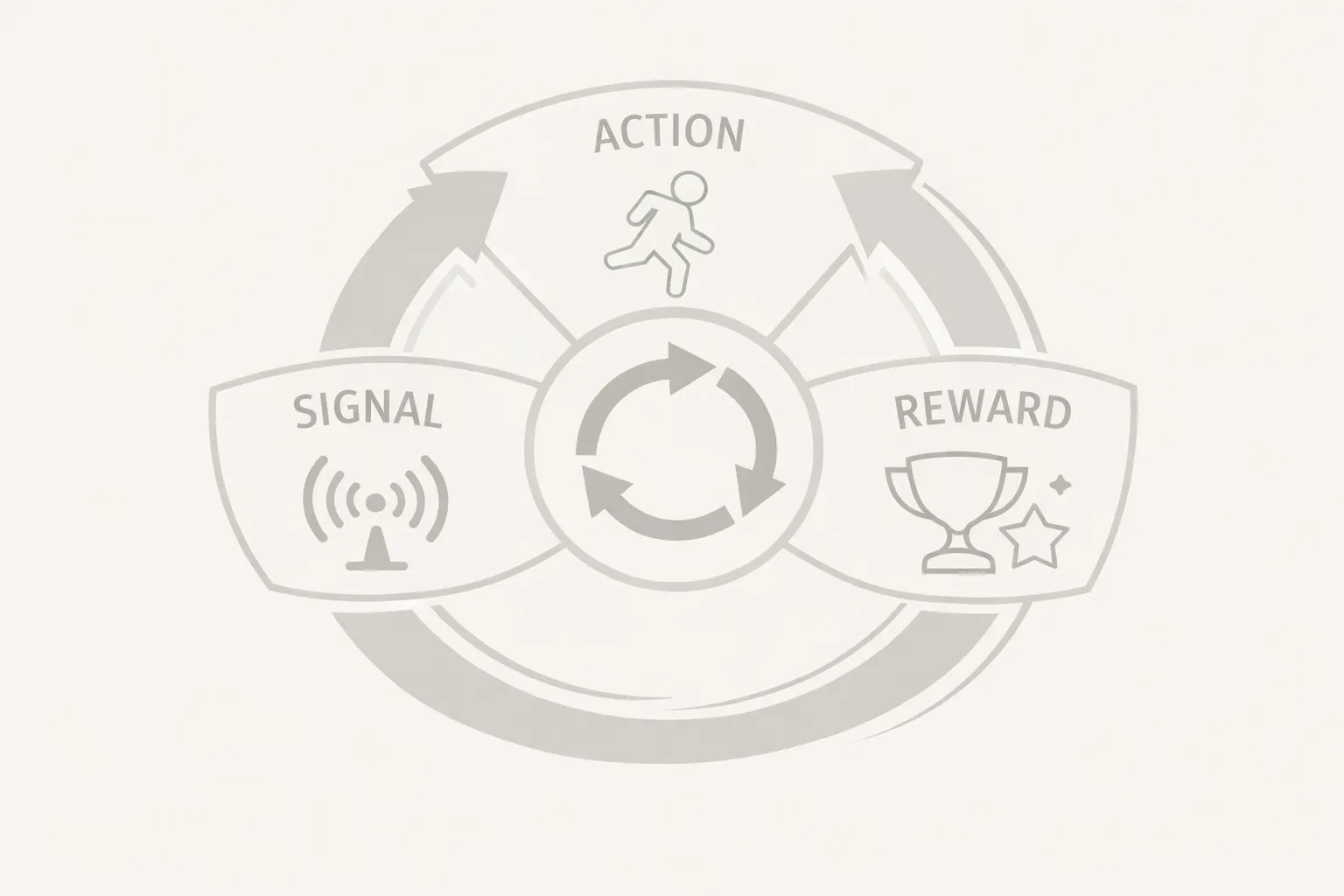
For example:
After dozens of repetitions the brain starts triggering this sequence automatically. That's how energy saving works. The brain constantly looks for ways to automate behavior to reduce the load on the prefrontal cortex — the area responsible for decision making. That's why habits require less effort over time.
From habit to system
A big mistake is trying to change life through goals. Goals are important, but they don't determine behavior.
A person can set a goal or point B:
write a book
lose weight
start meditating
But if the daily system doesn't change, the goal remains an intention. That's why in Atomic Habits the key idea is phrased like this:
you don't rise to the level of your goals — you fall to the level of your systems.
A system is a set of small actions that repeat every day.
For example:
Each action is small, but the system makes them regular.
The compounding effect of behavior
In The Compound Effect, Darren Hardy describes a simple pattern:
small decisions, repeated daily, create an exponential result.
Example. Two people start the year the same way.
The first makes small improvements:
reads 10 pages a day
walks for 20 minutes
reduces sugar intake
The second changes nothing, but only has a goal in mind.
After a week there's almost no difference.
After a month — still not much.
But after a few years the trajectories become radically different. Not because of one decision. Because of thousands of small actions.
Why micro-actions work better?
Small habits work for several reasons:
1. They don't provoke resistance
Big changes require willpower. Micro-actions require almost none. Two minutes of meditation are easier to start than 30.
2. They form identity
James Clear suggests seeing habits not as tasks, but as a confirmation of who you are.
Not "I want to write a book", but "I am a person who writes every day." Each small action becomes evidence of that identity.
3. They trigger inertia
After starting an action a natural continuation often appears.
Read one page → you read five.
Start stretching → you do a workout.
Starting is always harder than continuing.
From habits to remarkable results
An interesting feature of the compounding effect is that results don't appear immediately.
This period is sometimes called the plateau of hidden progress. A person doesn't see changes for a long time and thinks that nothing is working.
But accumulation is actually happening:
neural connections are strengthening
behavior becomes automatic
the system's resilience increases
Imagine ice at -5°C. You start heating the room:
But at 0°C there is a jump — the ice turns into water.
All previous changes were preparation for this moment.
The same happens with habits, and one day a moment appears when changes become noticeable. It looks like a sharp rise, although it's actually the result of a long accumulation.
Practical formula for habits
From the ideas of Atomic Habits and The Compound Effect you can derive a simple formula:
1. Start with a minimal action
For example:
2 minutes of reading
5 push-ups
1 journal entry
2. Anchor it to an existing habit
This is called habit stacking.
For example:
3. Repeat daily
Regularity is more important than scale. Better 1% daily than rare bursts of motivation.
How long does it take to form a habit?
One of the most cited studies is from University College London (2009), where 96 participants over 12 weeks tested forming habits like drinking water, running, eating fruit.
Results:
The most famous case of 1% improvements
In 2003 coach Dave Brailsford implemented the principle of “marginal gains” — improvements of 1%. What they did:
changed the saddle shape
optimized nutrition
improved mattresses for sleep
changed athletes' hand hygiene
developed aerodynamic suits
Each thing provided a minimal gain. But here are the results:
2008 Olympics — Britain won 60% of the gold medals in cycling
2012 Olympics — repeated dominance
the Team Sky team won 5 Tour de France titles in 6 years
This is one of the most famous real examples of the compounding effect.
Key takeaway
Big results rarely come from one big action. They arise from a long chain of small decisions. Every day a person makes dozens of choices. Each choice either slightly improves the trajectory or slightly worsens it.
And over time these micro-choices form the difference between ordinary results and outstanding ones. The paradox is that most of these actions are so small they seem unimportant. But over time they build the entire structure of life.