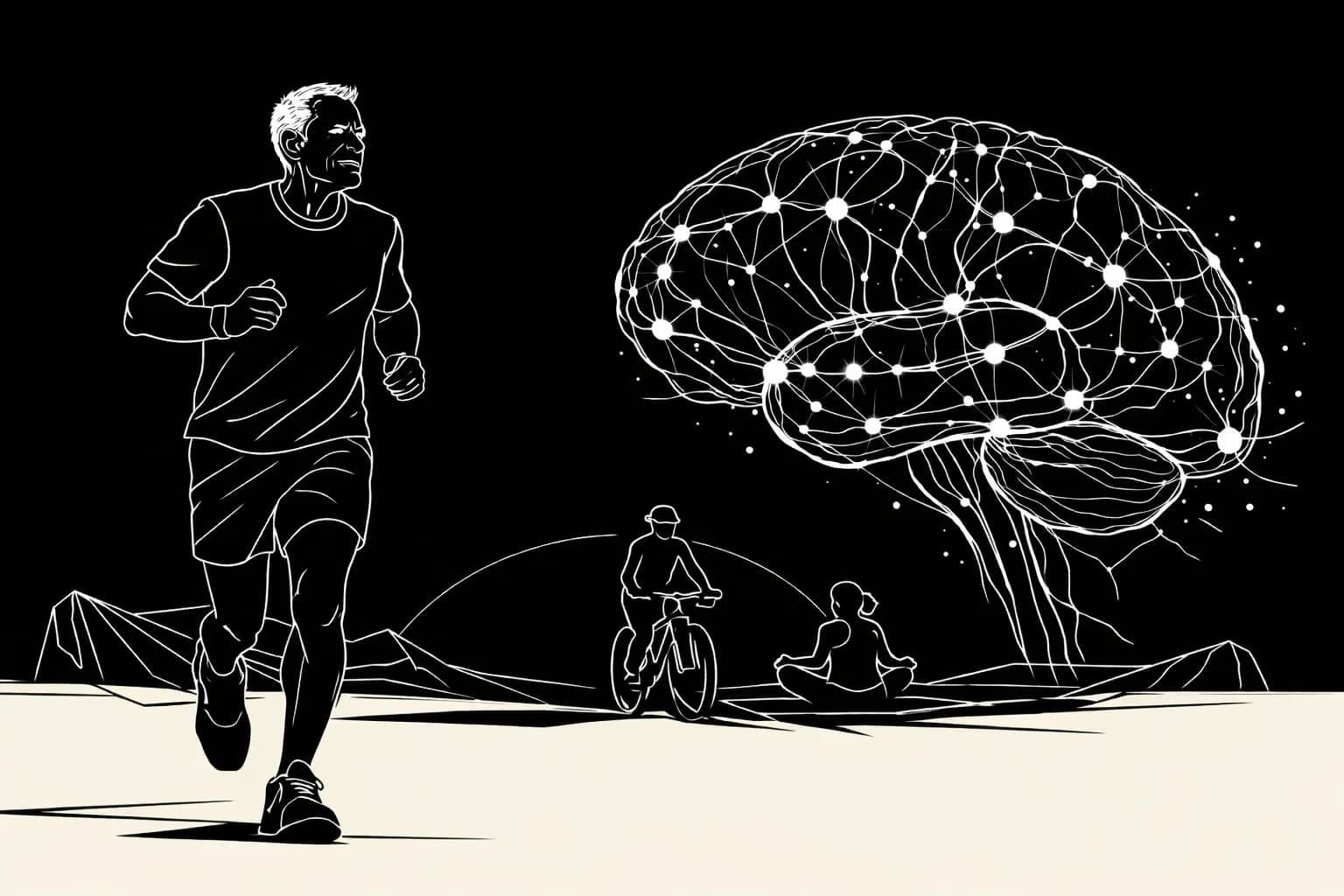
You don’t have to spend hours at the gym to lower your risk of dementia. Sometimes it’s enough to pick up the pace, climb the stairs briskly, or walk up a few flights carrying heavy bags. Researchers found that even short bursts of vigorous physical activity in everyday life are associated with a lower risk of developing dementia.
In a new analysis of data from the UK Biobank project, researchers found that just 3.7 minutes of vigorous everyday movement a day was associated with roughly half the risk of dementia. Notably, the main finding was observed among people who did not engage in regular sports or exercise.
However, this does not mean that a few minutes of activity are guaranteed to protect the brain from neurodegenerative diseases. The study has been published as a preprint and has not been peer-reviewed. Also, its observational nature means it cannot establish cause and effect: more active people may have differed from the outset in their health and other factors that affect dementia risk.
What researchers found among people who did not exercise
Zhi Cao and colleagues analyzed data from more than 22,000 participants with no diagnosed dementia who did not exercise. Between 2013 and 2015, they wore wrist accelerometers for seven days to record their movement. During the following eight years of observation, researchers recorded 170 cases of dementia. The study preprint was posted on SSRN on October 23, 2026.
Participants accumulated vigorous activity in short bursts. For bursts lasting up to a minute, the median total time was 3.7 minutes a day. This duration was associated with a 48% lower risk of dementia compared with no such activity.
This is a relative estimate, not a 48-percentage-point decrease in the likelihood of developing the disease. To put the scale in context: in a separate comparison of groups, the eight-year cumulative incidence of dementia was about 2.5% among non-exercisers with no vigorous everyday activity, and 0.7% among non-exercisers who did this kind of activity. These group-level figures cannot be directly applied to an individual who moves for exactly 3.7 minutes a day. The Bredesen protocol for reducing cognitive decline has been studied separately.
What counted as vigorous activity
The authors studied VILPA, an acronym for short bursts of vigorous physical activity incorporated into everyday life. The analysis included bursts lasting up to one minute and up to two minutes. These were efforts outside of planned workouts.
Examples might include climbing stairs briskly, carrying heavy groceries, or hurrying to catch a bus. However, an accelerometer records movement, not what someone was doing in daily life. The data cannot show that participants were necessarily running to a bus stop or climbing stairs with bags.
The CDC talk test can help explain what vigorous activity feels like: during vigorous aerobic activity, your breathing becomes fast enough that you can say only a few words at a time without pausing for breath. This is a practical guide for readers, not a description of the algorithm used by the study authors.
Brisk walking is usually considered moderate activity. How strenuous a particular effort feels depends on a person’s fitness and health. So four minutes of any kind of walking cannot be considered equivalent to the activity studied.
How short bursts of activity might be linked to brain health
One possible explanation relates to the cardiovascular system, whose functioning affects the blood supply to the brain. Vigorous activity may be part of this connection, but the new analysis did not establish the biological mechanism behind the observed finding.
MRI data provided additional information. In a subset of participants, more time spent in vigorous everyday activity was associated with greater gray matter volume and less white matter hyperintensity volume. The latter appear as brighter areas on certain MRI images and may reflect, among other things, vascular changes.
This was a cross-sectional analysis: researchers compared measurements but did not track how they changed in response to activity. So it is not possible to conclude that movement increased brain volume or reversed changes that were already present.
Why four minutes should not be considered a protective threshold
3.7 minutes was the median duration of activity, not an established minimum dose for prevention. It was the total time spent in short bursts over the course of a day. The study does not recommend a mandatory, continuous four-minute workout.
Long-term observational studies help researchers look for links with future illness. Scientists are also studying brain activity and Alzheimer’s risk. But reverse causation is especially relevant when it comes to movement: a disease that had not yet been diagnosed may have reduced a person’s ability to move quickly and vigorously long before they received a diagnosis.
Activity was also measured for just one week. It is not known how accurately that week reflected the participants’ habits in the years that followed. Whether deliberately increasing this kind of activity offers protection against dementia remains to be tested in intervention studies.
What you can take from the study for everyday life
The practical takeaway is that movement outside the gym deserves attention, too. If your usual level of activity feels comfortable, you can gradually add effort to everyday routes–for example, by taking the stairs for part of the way or choosing a route with an incline. There is no need to deliberately carry excessively heavy bags or run for transport.
These bursts should be viewed as a complement to overall physical activity. The WHO guidelines recommend that adults get 150–300 minutes of moderate-intensity aerobic activity or 75–150 minutes of vigorous-intensity aerobic activity per week, or an equivalent combination of the two. The new preprint does not justify replacing this amount with four minutes of movement a day. Read more about the weekly target and heart health in our overview of 150 minutes of movement.
Increase activity gradually. The CDC recommends that people with chronic conditions talk with a healthcare professional before moving to vigorous activity. Starting with movement that feels manageable makes more sense than trying at all costs to reach the number of minutes that was associated with lower risk in the study.
Is this specifically about Alzheimer’s disease?
The finding described here relates to dementia overall. Alzheimer’s disease is one cause of dementia, but this estimate cannot automatically be applied to any one type of the disease.
Do I need to buy a fitness tracker for this kind of activity?
No. The study does not provide a reason to buy a tracker to prevent dementia. Sensors were used to measure activity for research purposes; this study did not test whether a consumer device helps reduce risk.
Is there an additional benefit if I already exercise regularly?
This finding does not establish any additional benefit from short bursts of everyday effort on top of regular exercise. The main estimate came from participants who did not exercise, so it cannot be used to calculate the personal benefit of adding more activity.