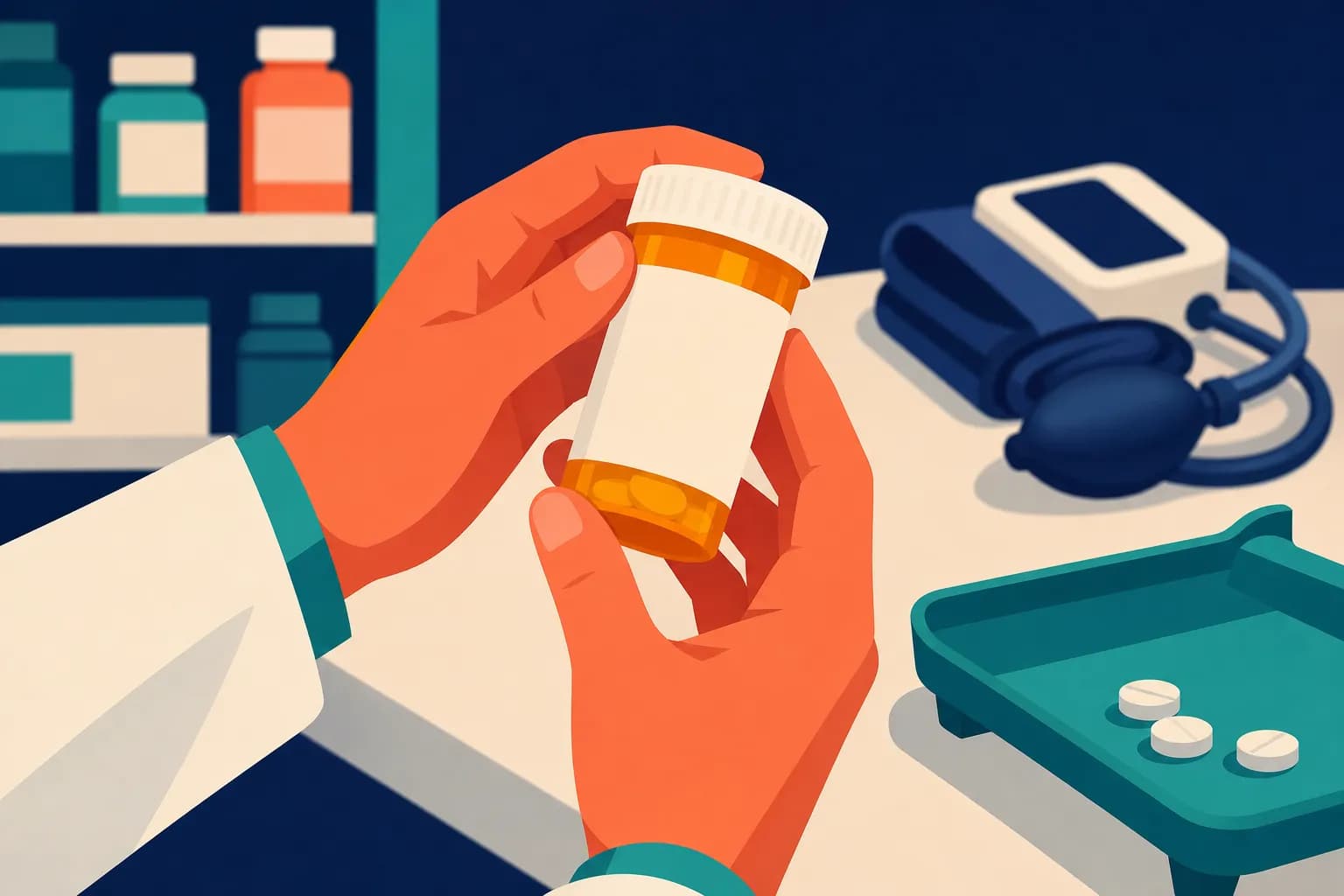
In the U.S., 3,744 bottles of Macleods Pharma USA combination medication for high blood pressure are being recalled. The tablets contain olmesartan medoxomil, amlodipine, and hydrochlorothiazide. The reason for the recall: certain lots failed a dissolution test, which helps assess how the active ingredient is released from the tablet.
The notice concerns specific lots and a specific strength, not all medications containing these ingredients. It describes a quality defect related to the dissolution of olmesartan; it does not report the discovery of toxic impurities.
Which lots of the blood pressure medication are being recalled
Macleods initiated the recall on October 7, 2026. The FDA, the U.S. Food and Drug Administration, classified it as Class II on October 26. The recall covers 3,528 bottles of 30 tablets and 216 bottles of 90 tablets. The medication was distributed throughout the United States.
The following lots are listed in Macleods' notice to pharmacies and retailers, published by the California Board of Pharmacy on October 23:
The strength lists the amounts of the ingredients in this order: olmesartan medoxomil, amlodipine, hydrochlorothiazide. On the U.S. label, the last number may be written with a decimal point: 12.5 mg.
Matching the medication name alone is not enough. You need to check the manufacturer, strength, and lot number.
How the tablet's three ingredients work
The combination lowers blood pressure in several ways:
Olmesartan blocks receptors for angiotensin II, a substance that narrows blood vessels and contributes to sodium retention.
Amlodipine blocks calcium channels in the smooth muscle of blood vessels and helps the arteries relax.
Hydrochlorothiazide is a thiazide diuretic: it increases the amount of sodium and water excreted by the kidneys.
These ingredients are combined to target different mechanisms that raise blood pressure. When a combination tablet is recalled, the entire medication should be replaced according to an agreed plan. You should not choose another medication on your own based on just one active ingredient: the new regimen may differ in composition and effect.
What failure to meet dissolution requirements means
A tablet must release its active ingredient before it can be absorbed and take effect. A laboratory test checks what proportion of the ingredient dissolves within a specified time under standard conditions. The FDA uses these tests for quality control and to assess potential bioavailability issues, meaning how a substance enters the body.
In this case, the failure was identified during stability testing. These tests help determine whether a medication retains its required properties during storage. The notice concerns the dissolution of olmesartan.
For patients, the potential concern is that the active ingredient may be released differently than required for the medication. This creates uncertainty about its effect. However, a laboratory test result alone does not prove that every tablet is ineffective or that everyone who took it experienced poorer blood pressure control. The published information does not indicate how many patients, if any, experienced clinical consequences.
How serious is an FDA Class II recall?
According to the FDA's definition, Class II means that use of the medication may cause temporary or reversible adverse effects, while the likelihood of serious harm is considered low. This is a risk category for a specific recall, not an assessment of how well the medication lowers an individual person's blood pressure.
A lot recall should also be distinguished from the question of whether an experimental substance is approved for use, which we discussed using retatrutide as an example. Here, the practical task is to check a specific package and arrange a replacement if it is affected by the recall.
How to check your package and arrange a replacement
Find the medication name, manufacturer, strength, and lot number on the label. The lot number is usually marked with the word Lot. Compare it with 12251163A and 12251163B.
Also note the NDC, the U.S. drug product identification code. Ask your pharmacist to compare the medication name, strength, NDC, and lot number with the recall notice.
If the pharmacy dispensed the tablets in its own bottle and there is no lot number on it, contact that pharmacy directly. Ask them to check which lot the medication came from. The date you picked up your prescription alone won't tell you this.
If the lot matches, ask your pharmacist or prescribing doctor how to get a replacement and what to do with the remaining tablets. The published notice is addressed to pharmacies and retailers and does not provide detailed instructions for patients on exchanging the medication.
If you are running low on tablets, let them know right away. Arrange the replacement so that you do not interrupt your treatment on your own.
Do not stop taking the medication or change your dose on your own. The FDA explains that with Class II and III recalls, people can generally continue taking the medication unless the company has given other instructions: stopping treatment can sometimes be more dangerous than continuing it. But this is general guidance. Ask your doctor or pharmacist whether to keep taking the medication from your specific package and when to replace it, taking the instructions for this particular recall into account.
If you monitor your blood pressure at home, keep a record to discuss with your doctor. Normal readings cannot verify the quality of a lot, and high blood pressure alone does not establish that the recalled tablets were the cause.
Can you tell there is a problem by looking at the tablet?
You cannot reliably identify a dissolution problem by looking at the tablet. A normal color, an intact coating, and no unusual smell are not a substitute for laboratory testing. For patients, the lot number is the key reference.
Can I temporarily replace the combination with three separate medications?
This may sometimes be possible, but a doctor must confirm the regimen. The doses of all the ingredients, other medications you take, and your health must be taken into account. Do not put together a combination yourself using tablets you have at home.
Do I need special tests if I have already taken tablets from a recalled lot?
Taking medication from a recalled lot does not automatically mean that you need special tests. Your doctor will determine whether an examination is needed based on your blood pressure readings, how you feel, and any other health conditions. Tell them the lot number and approximately when you took the medication.