Can You “Order” a Dream That Helps Solve a Problem?
Published on: ⋄8 min read
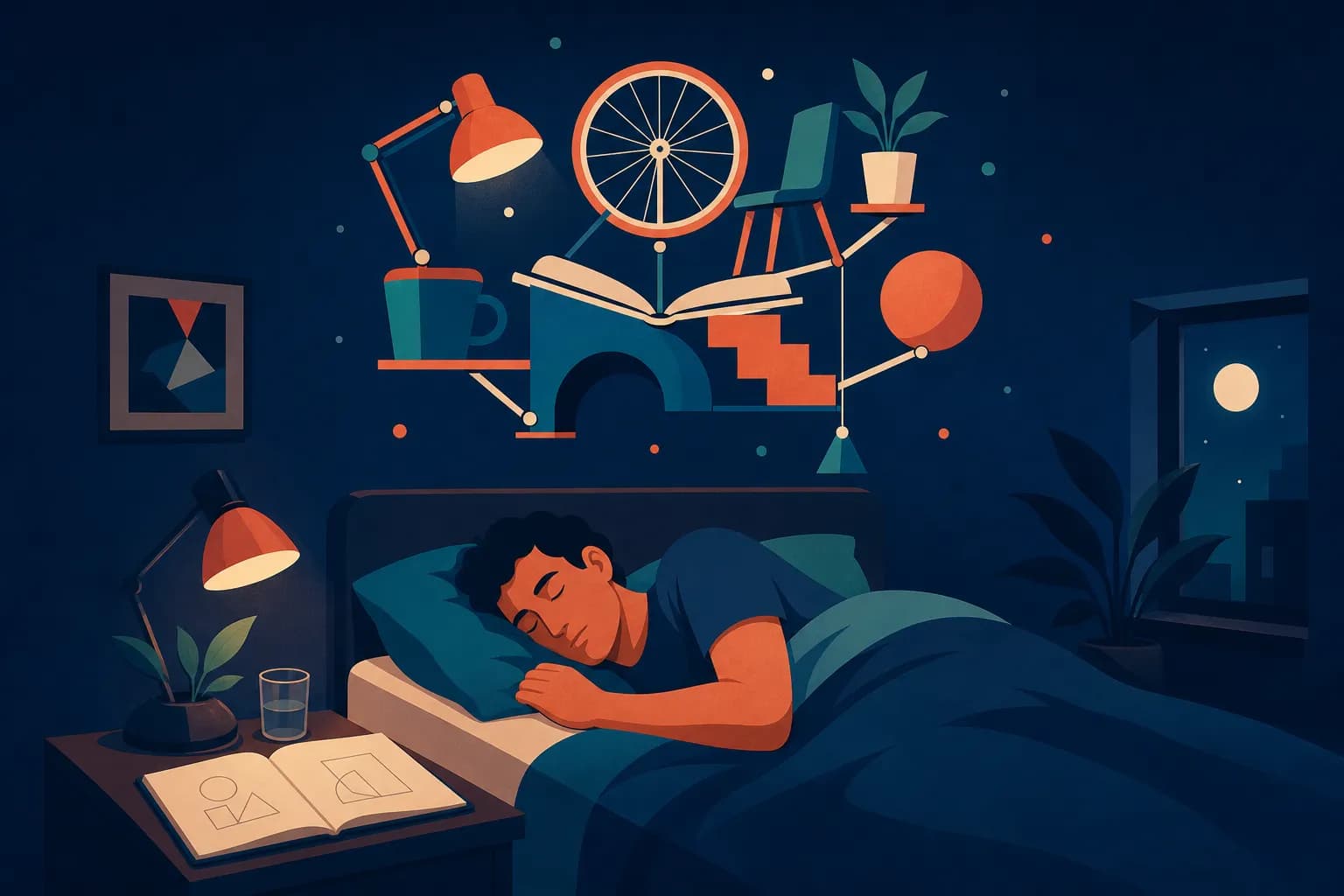
Can you ask yourself a question before bed and wake up with a new idea? In an experiment by Adam Haar Horowitz and colleagues, participants who were prompted to dream about a particular topic as they were falling asleep later performed better on creative tasks related to it. The practice of intentionally focusing on a topic before sleep is called dream incubation.
However, influencing a dream’s storyline, coming up with an unusual idea, and finding the right solution to a problem are three different outcomes. Science cannot yet guarantee that you can “order” a useful answer. But you can use a dream as a source of hypotheses to test in the morning.
What Is Dream Incubation?
Dream incubation begins with a simple action: before going to sleep, a person focuses on a chosen topic and sets an intention to dream about it. The topic might be a creative task, a challenge at work, or a question about their own feelings. In a laboratory, researchers sometimes add audio cues to prompt dream reports.
This differs from lucid dreaming, in which a person realizes they are asleep. Lucid awareness is not necessary for dream incubation. You can simply fall asleep, have an ordinary dream, and only notice its connection to your evening question after waking up.
“Order” is more of a metaphor here. Setting an intention before sleep may make certain images more accessible, but it does not give you complete control over the storyline. A question about a work project might turn into a story about building a house–or might not appear in a remembered dream at all.
It helps to decide in advance what you’re hoping for:
Dreaming about a particular topic. This is a question about dream content.
Having an unexpected association. This is a question about creative novelty.
Finding a workable solution. This requires checking it against the constraints of the task and its real-world consequences.
For example, an unusual idea for a story may be useful in its own right. A hunch about another person’s intentions needs independent evidence, however convincing it may seem in a dream.
How Nighttime Associations Might Help With a Problem
One working hypothesis is that during sleep, familiar elements of experience combine in unfamiliar ways. Someone who is stuck in one approach to a problem may encounter a different set of associations. This can sometimes help them notice an option they had overlooked while awake.
You don’t need to have a long, detailed dream for this to happen. Brief images can arise on the border between wakefulness and sleep. Dreams also occur during rapid eye movement, or REM, sleep–a phase named for the characteristic rapid movements of the eyes. Researchers study different parts of this process, so the results of one protocol cannot automatically be applied to the entire night.
Sleep can help with problem-solving even without a remembered dream. In a 2019 experiment published in Psychological Science, 57 participants first tried to solve puzzles, each paired with a particular sound. Some of the sounds were then replayed while participants slept. In the morning, participants solved about 32% of the puzzles with an overnight cue and about 21% without one.
These results are consistent with the possibility that memories associated with a task are reactivated during sleep. But they do not establish that the solution necessarily arose within a consciously experienced dream. Memory processes that people do not have direct access to may have helped.
There is also a simpler explanation: a person carefully formulates a problem in the evening, takes a break, and returns to it in the morning feeling rested. Without comparing this with other conditions, it is difficult to separate the contribution of sleep from the benefit of simply framing the question.
A dream report and physiological sleep data provide different kinds of information. The vividness of a dream cannot tell you how restorative a person’s sleep was.
What Experiments Have Been Able to Test
Thematic Dreams and Creative Ideas
A 2023 study published in Scientific Reports analyzed results from 49 participants randomly assigned to one of four conditions: sleep or wakefulness, with attention directed toward a given topic or not. The topic was a tree.
During an approximately 45-minute procedure, participants in the sleep conditions were woken several times and asked to describe the images that came to mind. Among those who received thematic cues, a tree appeared in an average of about 70% of dream reports. In the sleep group without incubation, the corresponding share was about 1%.
After the procedure, participants completed creative tasks: they wrote a story, came up with unusual uses for a tree, and worked on verbal associations. The sleep group with incubation received a higher combined creativity score than each of the other three groups.
This is an interesting result: directed sleep onset helped participants come up with more creative responses within a given theme. But the experiment tested a short laboratory protocol with repeated awakenings. It did not assess whether a single intention set in the evening helps someone make a good life decision.
Cues During REM Sleep
A 2026 study by Karen Konkoly and colleagues, published in Neuroscience of Consciousness, involved 20 people. Sounds associated with some of the unsolved puzzles were played during REM sleep. In the morning, participants solved an average of 30% of the cued puzzles and 22% of the uncued ones, but the overall difference was not statistically significant.
A more encouraging result emerged in an additional analysis of participants whose dreams responded more strongly to the sounds. But this subgroup was identified after the data had been collected, so the finding needs to be confirmed separately. In addition, the small sample consisted mostly of people with experience in lucid dreaming.
Together, these studies give researchers reason to continue investigating directed dreaming. So far, the evidence is more convincing for the possibility of changing dream content and supporting thematic creativity. Whether it can reliably help solve specific problems remains an open question.
A new combination of familiar images may suggest a hypothesis. Its usefulness becomes clear only after it has been tested while awake.
How to Try Dream Incubation Tonight
A home version is best treated as an optional experiment in attention. A similar sequence is described in Allison Aubrey’s article for NPR. It requires no equipment, special sounds, or reduction in sleep.
Choose one manageable problem. For a first attempt, pick a question with several possible answers: how to explain a complex idea, where to start with a piece of writing, or which element of a project you might be overlooking. It’s better to leave an acute conflict that is already keeping you awake for daytime reflection.
Write down an open-ended question. Instead of “Should I quit my job?” you might ask, “What exactly about my work needs to change?” This leaves room for observations and doesn’t force you to treat the dream as a vote for a single solution.
Briefly review the context. Note what you already know and where you’re stuck. Reread the question before bed. A few calm minutes are enough for the exercise; there is no scientifically established “dose” of reflection.
Set an intention, then let the problem go. For example: “If I dream about this question, I’ll try to remember it.” There’s no need to repeat the phrase until you feel tense or check whether you’ve focused hard enough.
After waking as usual, write down any fragments you remember. They might be a place, an action, an image, a phrase, or an emotion. First record the memory, then interpret it. If you don’t remember anything, write that down too.
Getting no results on the first night says nothing about your abilities. The likelihood of success with a home practice has not been reliably established, and laboratory findings cannot be used to predict it.
How to Check a Clue After Waking
In the morning, it can help to divide your notes into three parts: what you dreamed, what associations it brings up, and what you can test. This helps keep the dream storyline separate from conclusions about reality.
Suppose you’re looking for a way to simplify a presentation and dream about a suitcase that won’t close. One possible association is that there’s too much material. A testable hypothesis might be to remove secondary slides and show a shorter version to a colleague. The dream offered an image; clarity and feedback will determine whether the solution works.
In another case, you dream that a colleague closes a door in your face. This might remind you of feeling excluded, but it does not confirm that your colleague is actually hiding something. You can explore your own feelings, recall specific situations, and ask a direct question if needed. A dream storyline is not a basis for attributing motives to another person.
Evaluate how unusual an idea is separately from whether it is correct. For a creative task, ask whether the image helps you come up with several options. For a practical task, check the constraints, costs, and consequences. If it concerns health, money, or safety, confidence after a dream is no substitute for evidence or professional advice.
You can also write down ordinary morning ideas on days when you don’t try dream incubation. This won’t be a full-fledged experiment, but it may help you notice whether the practice offers anything beyond the usual benefits of rest and returning to a problem.
When to Skip the Nighttime Experiment
A home practice should not imitate laboratory awakenings. Don’t set several alarms, delay falling asleep, or try to stay on the edge of sleep at the expense of rest. The fact that something is part of a research protocol doesn’t make it a good everyday recommendation.
If an evening question sets off rumination, increases anxiety, or makes it harder to fall asleep, move your reflection to daytime. If recurring nightmares or persistent insomnia are affecting your well-being and daily life, it may be more helpful to discuss your sleep difficulties with a professional.
A modest practical measure of success is whether an idea worth testing emerged without compromising your rest. Sometimes that idea is simply a more clearly formulated question. That may be enough to help you move forward.
Is it worth trying if I rarely remember my dreams?
Yes, though it will be difficult to assess the effect on dream content. After waking as usual, you can write down even a single feeling or image. Not remembering a dream doesn’t prove that you didn’t have one; there’s no need to interrupt your sleep just to report it.
Will using a cue in a phone app help?
There is no reliable evidence that using an arbitrary cue at home is effective. In experiments, sounds were linked to specific tasks and presented according to a particular protocol. Even if an app collects data about your sleep, that alone does not demonstrate that it can direct your dreams or improve problem-solving.
How many nights should I repeat the same question?
There is no scientifically established time frame. You can try a few times if it doesn’t interfere with falling asleep, but repetition doesn’t guarantee an answer. If the practice starts to feel like an obligation or a test of your abilities, it’s more sensible to stop.