What if every night your body told a story about what will happen to your health in 5, 10, or even 20 years? It sounds like science fiction, but researchers from Stanford Medicine have created something incredible — an artificial intelligence SleepFM that has learned to decode these nightly messages.
Sleep is not just rest, but a key biological process directly linked to the state of the body and mind. Despite this, science still only partially understands how sleep features reflect the development of diseases. Polysomnography — the main clinical method for studying sleep — records a vast array of physiological signals, but these data are rarely used to their full potential due to challenges in standardization, differences between equipment, and difficulties in integrating different types of signals into a single analysis system.
The emergence of next-generation AI-models changes the situation. Researchers from Stanford Medicine have developed a revolutionary multimodal foundational AI model SleepFM, which learns to extract hidden physiological patterns from nightly sleep recordings.
Sleep is being regarded as a biological “journal” of the body, where early signs of future disorders may appear long before clinical symptoms.
Sleep is not just rest. It is a window into your future health. And now we are learning to look into this window in a new way.
Artificial intelligence listens to the language of your body
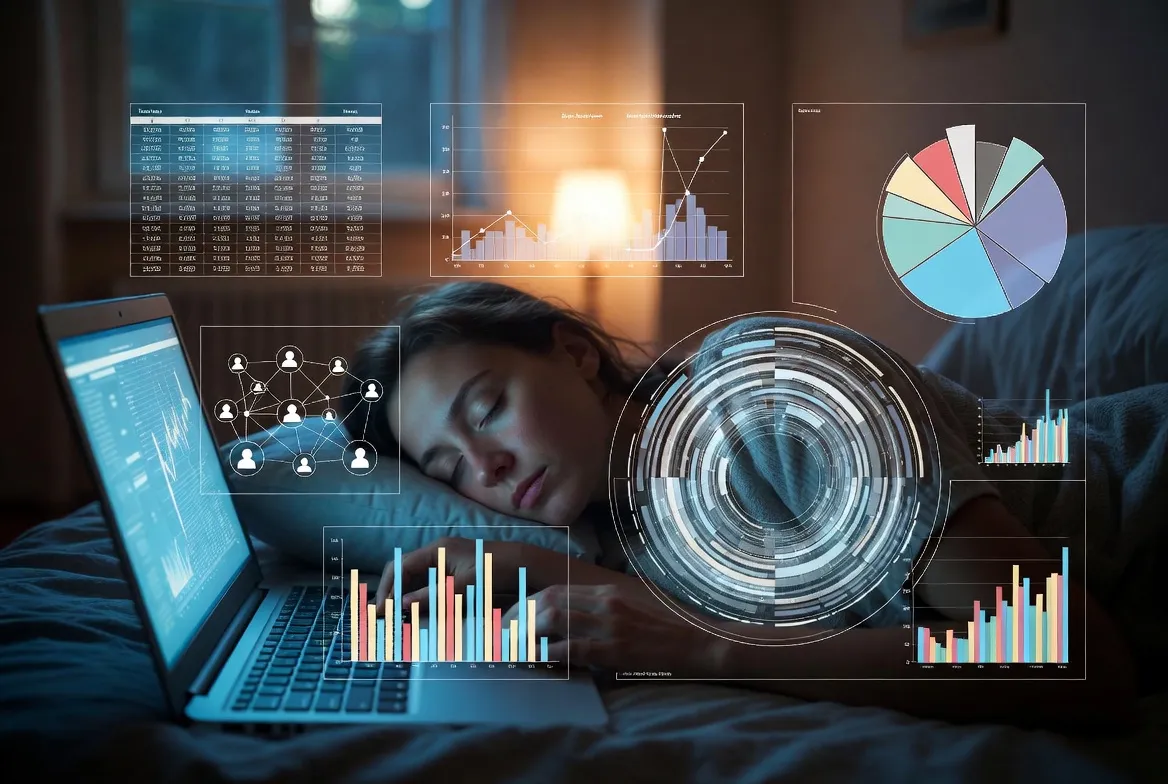
Do you know what is the most mesmerizing? This system works quite differently from how we are used to thinking about sleep analysis. It does not merely count how many times you woke up or how long you slept in deep sleep. SleepFM literally learns to understand the symphony of your body — how the heart beats in unison with breathing, how brain waves move, and how all these signals weave into a unique portrait of your health.
To learn this “language of the body,” the models had to study almost 585,000 hours of sleep from 65,000 people. Imagine — it’s as if one person slept continuously for 66 years! All these data were obtained through polysomnography — the gold standard of sleep research, where special sensors simultaneously monitor brain activity, heart activity, breathing, and movement.
Premonition of illness — in every breath
Researchers linked these nightly records with the medical histories of the same people over 25 years. And what did they find? It turns out that signs of future diseases are hiding in your sleep long before you feel any discomfort.
SleepFM learned to predict risks for more than a thousand different conditions:
Cardiovascular problems. Your heart at night can signal future heart attack or heart failure — years before anything goes wrong.
Neurodegenerative diseases. Dementia, Parkinson’s disease — these terrifying diagnoses also leave traces in night physiology before clear symptoms appear.
Cancer risks. Even some cancers seem to alter how our body operates at night.
Pregnancy complications and much more. The list goes on, and this is truly impressive — with accuracy above 80% for many conditions.
Why this changes the rules of the game
Think about what this means for each of us. Instead of waiting for disease to declare itself, we could receive early warnings — simply by falling asleep every night. It’s like having an invisible doctor who never sleeps and constantly monitors the slightest changes in your body.
The technology is truly smart: even if some sensors temporarily fail or malfunction, the system continues to analyze the other signals. It doesn’t just memorize patterns — it understands deep connections between all systems of your body.
The reality here and now
Of course, let’s be honest — we are not yet at a stage where you can simply wear smartwatches and get a full forecast for 20 years ahead. While SleepFM works with professional clinical equipment used in sleep laboratories, transitioning to home devices will take time and additional research.
It’s important to understand: this system predicts risks, not diagnoses. It’s more like a compass that points in the direction you should pay attention to, not a verdict.
What this means for you
We live in an amazing era when technologies begin to see what is hidden from our eyes. SleepFM is not just another smart program. It is a window into the future of personalized medicine, where prevention starts not with symptoms, but with the whisper of your own body.
Each night your body tells a story. Now we have a way not just to listen, but to understand these stories. And perhaps very soon this understanding will help save millions of lives — simply by allowing people to act before it’s too late.