
Kratom as a Wellness Supplement: Why It Can Be Addictive
Kratom is promoted through health podcasts, fitness influencers, and free samples. We explore how its image as a natural supplement differs from its effects and risk of dependence.

⋄5 min read

Fires in residential areas are dangerous not only because of the flames and destruction. As homes, cars, furniture, and building materials burn, they release substances that can turn smoke into a toxic mixture of heavy metals and other pollutants. Some of these can travel far beyond the fire zone through the air and pose a health risk.
Scientists from the California Institute of Technology (Caltech) and other research organizations studied the composition of smoke after the massive Eaton Fire, which swept through Los Angeles County in January 2025. They found elevated concentrations of lead, arsenic, and other elements. During the period when residential areas were burning most intensely, the researchers estimated that the average daily concentration of lead in the air was more than 80 times the background level.
The findings, published on October 28, 2026, in the journal Science Advances, show how strongly smoke composition depends on what is burning. The study assesses air pollution and potential exposure to toxic substances, but it does not establish how many people were actually poisoned or had elevated blood lead levels.
The authors compared measurements from two fires. Eaton Fire smoke was studied at a monitoring station in Pico Rivera. For comparison, they used data collected at a station in Rubidoux during the Airport Fire in September 2024, which primarily destroyed vegetation.
Compared with smoke from a vegetation fire, smoke from the urban phase of the Eaton Fire contained more than 50 times as much lead, about three times as much arsenic, and about seven times as many halogens. Caltech’s announcement identifies chlorine and bromine among the halogens.
This refers to the chemical composition of particles. Chlorine and bromine are halogens, not heavy metals. Finding these elements in particles does not, by itself, mean that researchers measured concentrations of gaseous chlorine or bromine.
The comparison shows why simply labeling something “wildfire smoke” is not enough: burning vegetation and burning a residential neighborhood can produce significantly different mixtures of pollutants.
In a residential neighborhood, building materials, finishes, and household contents become fuel. Their chemical composition differs from that of wood, leaves, and grass. When buildings are damaged and burn, substances from these materials can enter the air along with particles.
The change in smoke composition could also be tracked as the fire moved. When the Eaton Fire moved from developed areas into the mountains, the ratio of potassium to lead rose from about 5:1 on January 8–9 to 50:1 on January 11. The next day, it reached hundreds to one. For researchers, this provided a chemical sign that the burning material had changed: the lead signature was weakening relative to potassium.
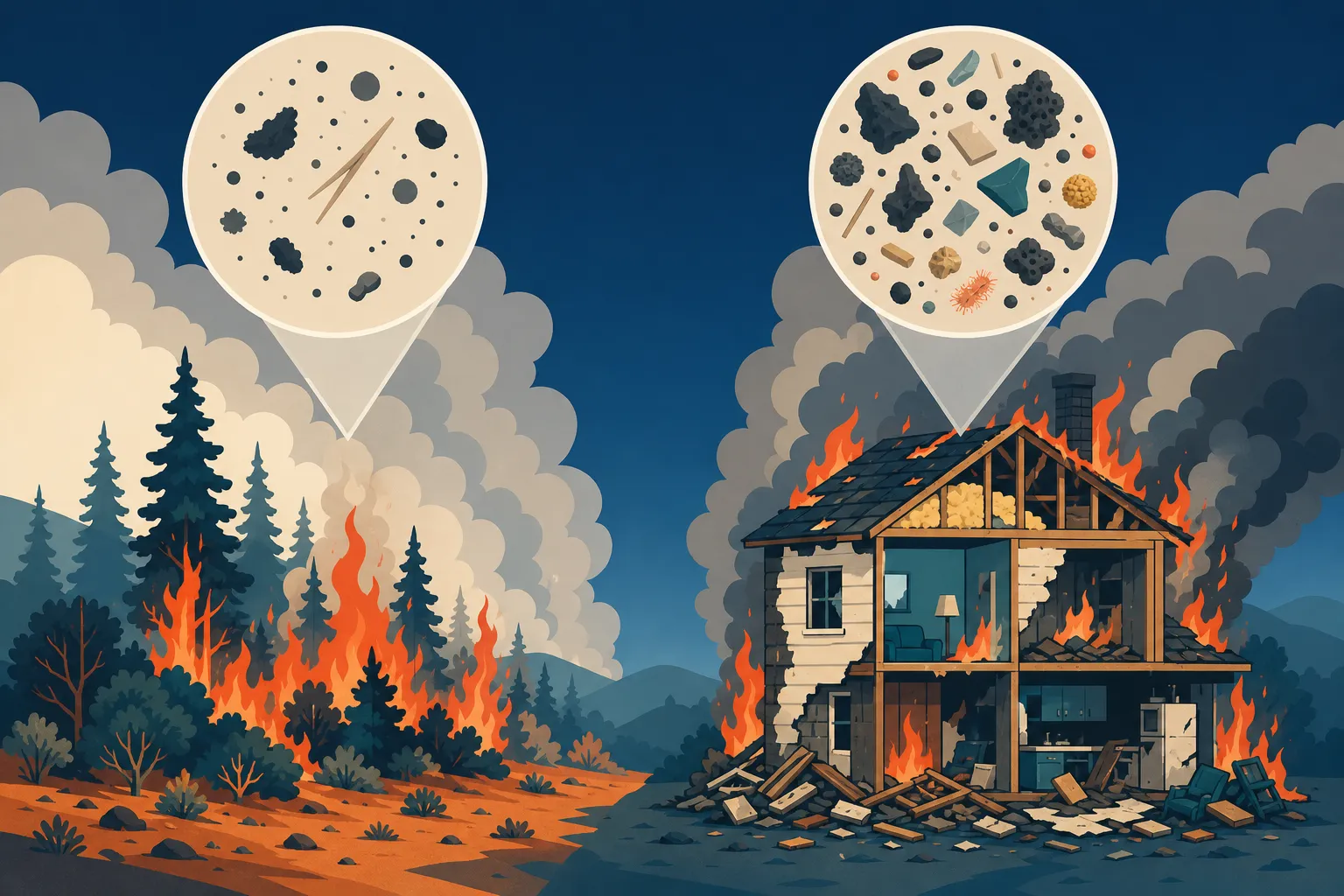
According to the study abstract, during the period when residential areas were burning most intensely, about 7 million people lived in an area where the average daily concentration of lead exceeded 50 nanograms per cubic meter of air. This level was more than 80 times the background level.
This is an average concentration over 24 hours, not a brief, momentary spike. And this is a different comparison from the one between the Eaton Fire and the Airport Fire: “more than 50 times” describes enrichment relative to smoke from a vegetation fire, while “more than 80 times” refers to the background level.
Background levels provide a reference point for measuring pollution. They should not be equated with a medical threshold, and an increase over background cannot be translated into the same increase in disease risk.
The figure of about 7 million residents does not mean that 7 million patients were examined. Outdoor concentrations do not determine an individual’s dose, which depends on how long they were exposed to smoke, how much time they spent indoors, and other conditions. The study characterizes the scale of potential exposure but does not establish the consequences for each person.
Particles containing lead provide a route for it to enter the body when inhaled. According to the World Health Organization, lead is especially dangerous for young children: it can cause irreversible damage to the development of the central nervous system.
The WHO says there is no known level of lead exposure that is guaranteed to cause no harm. This is a reason to reduce contact with the pollutant, but it does not mean that any brief exposure will necessarily cause a noticeable illness.
A significant gap remains in assessing the effects of the Eaton Fire: air measurements do not show how much lead entered residents’ bodies or how it affected their health. Particular caution is warranted when judging the effects of brief, high-level exposure, which is less well studied than the effects of long-term exposure.
The amount of fine particles remains a useful measure of air pollution. This new study shows why information about chemical composition should be added: the same label, “smoke,” can conceal very different mixtures of substances.
For residents, the practical takeaway is to pay attention to reports that residential areas are burning and follow local authorities’ instructions on evacuation and smoke protection. Distance from the flames is not the only thing to consider: pollution travels with the airflow.
At the same time, the Eaton Fire ratios cannot automatically be applied to every urban fire. Building age, materials, and burning conditions vary. Assessing a specific event requires measurements from its own smoke plume.
No. The smell of smoke cannot tell you how much lead it contains. That requires chemical analysis of the air or collected particles. A faint smell does not confirm that there is no pollution, either.
Exposure to smoke does not automatically mean that everyone needs a test. Whether screening is appropriate should be discussed with a doctor, taking the circumstances of exposure and local public health guidance into account, especially when a child is involved. Lead levels in the body are assessed with a blood test.
Yes. If particles containing lead settle in dust or ash, they can become a separate source of exposure. However, the study of the Eaton Fire smoke plume does not establish the degree of contamination at any particular home or site after the fire; that requires a separate assessment.
How was this article?
Share