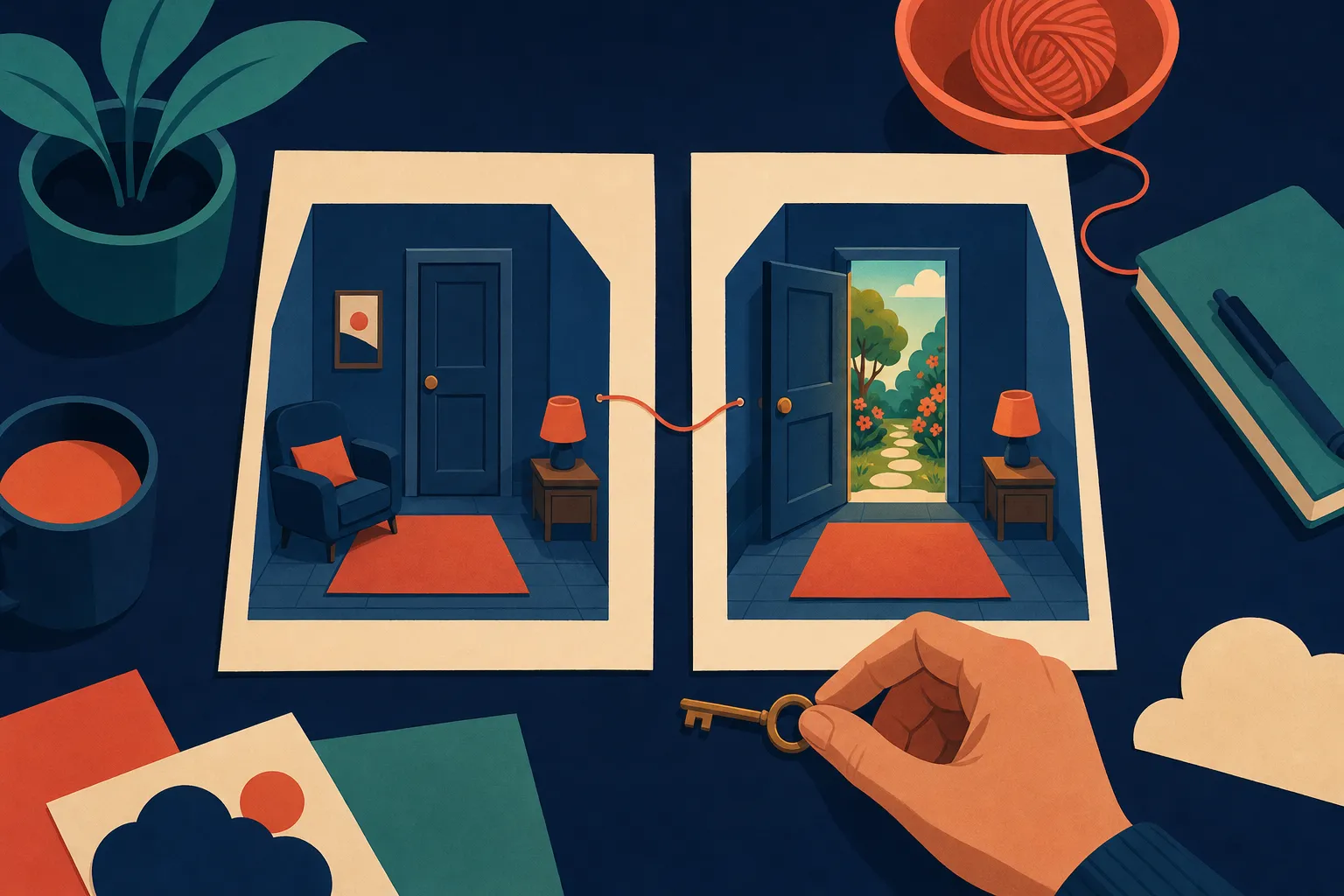
You’re awake, you recognize your room, but the fear from the dream hasn’t let go yet. If a nightmare keeps recurring, you can try changing its story while you’re awake. This is the basis of imagery rehearsal therapy, or IRT: a person creates a different version of the frightening story and regularly imagines it while awake. For some people, this practice reduces the frequency of nightmares and the distress associated with them.
The method’s clinical outcomes have been studied more thoroughly than its mechanisms. IRT does not promise complete control over dreams, and the idea that rewriting a nightmare builds general self-confidence goes beyond the evidence currently available.
Why the brain creates nightmares
A nightmare feels like a threat, even when its story is impossible: a familiar house changes shape, the way out disappears, or a chase never ends. In a dream, people often take what is happening for reality. After waking, the realization “it was a dream” may come before the heartbeat, tension, and fear have had time to subside.
Vivid dreams are usually associated with REM sleep, the phase characterized by rapid eye movements. However, dreams can also occur in other sleep stages. So it would be inaccurate to explain all scary dreams solely through the features of REM sleep.
Neurobiological models of nightmares focus on interactions among systems involved in emotion, memory, and regulation. The amygdala contributes to evaluating emotional significance and threat. The hippocampus helps connect memories with context. The prefrontal regions and anterior cingulate cortex contribute to evaluating what is happening and regulating emotional responses. These functions are distributed across many structures; there is no single “nightmare center.”
In the model discussed by sleep researcher Tore Nielsen, disrupted interactions in this network may make it harder to reduce fear and place frightening images in a safe context. This is an explanatory model, not an established universal cause of nightmares. The idea that the prefrontal cortex completely “shuts down” during a scary dream oversimplifies how the brain works.
According to information from the NHS, nightmares may be linked to stress, anxiety, severe fatigue, certain medications, and sleep disorders, including sleep apnea. A frightening dream on its own does not indicate psychological trauma or PTSD. Nor is there general agreement that every nightmare necessarily serves a useful function, such as rehearsing survival.
Can you change a nightmare after waking up?
A dream you’ve already had will remain part of your past experience. But you can change its imagery in your imagination so that it is no longer the only available version of the story.
Imagery rehearsal therapy (IRT) involves several steps: choosing a nightmare, changing its frightening elements, and mentally rehearsing the new version while awake. You can change the beginning, what happens next, the setting, your own actions, or the ending. You don’t need to learn how to become lucid in your dreams.
In its 2018 position paper, the American Academy of Sleep Medicine recommends IRT for nightmare disorder and nightmares associated with PTSD. Nightmare disorder involves recurring nightmares that cause significant distress or interfere with everyday life. A single scary dream does not, by itself, qualify as this disorder.
The distinction is illustrated by a 2024 meta-analysis of 15 studies involving military veterans. In groups receiving imagery-rewriting interventions, nightmare frequency decreased, but the difference compared with control groups was not statistically significant for this outcome. The review included different types of interventions, so its findings cannot be attributed entirely to one standard IRT protocol.
Why rewriting the story may reduce fear
A recurring nightmare exposes a person to the same sequence again and again: danger appears, an attempt to escape doesn’t help, and the story ends in helplessness. Sometimes the anticipation of this sequence starts to feel frightening even before bedtime.
IRT offers several possible ways to change this response:
The frightening image gets a different continuation. The imagination no longer has to move toward the familiar catastrophe each time.
When recalling the story, a person can experience safety, help, or the ability to act.
Working with the image may reduce avoidance and the expectation of inevitable danger.
These are hypotheses about psychological mechanisms. IRT’s exact neurobiological mechanism has not yet been established. It cannot be confidently claimed that the exercise “rewrites the neural fear circuit,” erases traumatic memories, or restores one brain region’s control over another.
The practical implication of these hypotheses is clear: when trying the method, you don’t have to force yourself to relive the original terror in detail over and over. Most of the rehearsal time is spent on the changed version.
Bandura’s self-efficacy: how a sense of influence relates to fear
Psychologist Albert Bandura used the term self-efficacy to describe a person’s belief in their ability to carry out the actions needed to achieve a particular outcome. It is not a general positive evaluation of yourself. You may believe you can handle a work task and still feel completely helpless in the face of recurring nightmares.
Rewriting a dream offers an interesting shift: someone who can only endure what is happening in the dream becomes the author of a possible continuation while awake. In theory, this experience may support the feeling, “I can do something about this problem.”
This idea is already being tested. A randomized study of IRT with telephone support involved 70 people. By the midpoint of treatment, an increased sense of being able to influence the nightmare story statistically explained some of the subsequent reduction in nightmare frequency and distress. People with possible PTSD were not included in the study.
This finding supports the hypothesis, but does not establish a causal mechanism: the change in perceived control may have occurred alongside other beneficial changes. In addition, the researchers assessed effects on a specific sleep-related problem. The findings cannot be generalized to self-esteem, confidence in relationships, or the ability to cope with all of life’s challenges.
It is helpful to keep three levels in mind: IRT’s ability to reduce symptoms is supported by several clinical studies; explanations of how it works in the brain remain models; and a boost in general self-confidence is still a broader hypothesis.
You can change any part of the story in the new version: add an exit, help, or the ability to act differently.
Practice: how to rewrite your own nightmare
The following steps introduce the principle of IRT. They do not replace individual therapy, especially if the nightmare is connected to a traumatic event or causes a significant worsening of your condition.
Choose a calm time while you’re awake. For your first try, it’s sensible to choose a story you can briefly revisit without being overwhelmed by fear. You don’t have to start with your most distressing nightmare.
Briefly outline the original story. A few sentences are enough: where you are, what frightens you, and how the dream usually ends. You do not need to describe traumatic events in detail.
Change what makes the story unbearable. You can remove the threat, add an exit, a helper, protection, or the ability to stop what is happening. The new version should feel desirable and acceptable to you. You don’t have to defeat an opponent or invent a triumphant happy ending.
Write the new version as a complete, short story. For example, in the original dream, you can’t get out of a room. In the changed version, you have a key, the door opens, and beyond it is a familiar, safe place. This is an editorial illustration of the principle, not a separately tested technique.
Mentally rehearse the changed story while awake. Imagine the sequence of events in whatever way works for you. You don’t need to make it cinematic or constantly check whether you’re doing the exercise well enough.
The AASM guidelines describing the IRT procedure suggest rehearsing for 10–20 minutes a day. This is not a universally proven “dose” that you should follow at any cost. The optimal duration is still being studied. If you’re trying the method on your own, choose a time during the day, especially if working with images in the evening makes it harder to fall asleep.
If your fear suddenly intensifies, you experience flashbacks, or you feel disconnected from what is happening, stop the exercise. Experiences resembling derealization are also a reason to discuss further practice with a professional. This is a precaution, not a requirement to endure discomfort until it reaches a certain threshold.
To notice any changes, you can briefly track how often nightmares occur, how intense the fear is after waking, and how they affect your sleep. If keeping records makes you fixate more on the nightmares, you don’t need a detailed journal. Not improving does not mean you didn’t try hard enough.
What to do with fear right after waking
At night, the first step is to reconnect with the present. Look around and, if needed, turn on a soft light. Name a few objects, notice the support beneath your body, and remind yourself where you are and that you’re awake.
You can pay attention to your natural, easy breathing. If focusing on your breath makes you more anxious, concentrate on details in the room or on the feeling of your feet. These grounding techniques are included in the recommendations of the 2025 expert consensus on cognitive behavioral therapy for nightmares. This approach is broader than IRT alone.
You don’t have to rewrite the story immediately after waking. You can return to daytime rehearsal when you feel calm enough. At night, the only task may be to feel safe again.
When to seek professional help for nightmares
Consider seeking help if nightmares happen regularly, interfere with your sleep, or affect your daily life. For example, you put off going to bed because you’re afraid, don’t feel rested in the morning, or take a long time to readjust after waking. This is in line with NHS recommendations.
If you suspect you have PTSD, are experiencing significant depression, or react strongly to memories, it is safer to learn the method with a trained professional. IRT can be part of your care, but it does not replace treatment for a co-occurring condition.
If nightmares started after you began taking a medication or changed your dose, discuss it with the prescribing doctor. Do not stop taking the medication on your own. Loud snoring, observed pauses in breathing, dangerous movements during sleep, and injuries require medical assessment; working with the story alone is not enough.
The goal of treatment can be described without promising perfect dreams: nightmares disrupt your sleep less often, and it becomes easier to return to everyday life after waking. You don’t have to learn to control everything that happens in a dream.
Do I need to have lucid dreams to try IRT?
No. IRT is practiced while awake. The method does not require you to recognize that you are dreaming, wake up on a schedule, or change the story while you are dreaming.
Does the rewritten story have to appear in my dreams?
No. The expert consensus on nightmare therapy notes that most patients do not dream about their new scenario. Reproducing it exactly is not a measure of whether therapy is working.
Does a violent dream mean that I want it to happen?
No. Dream content on its own does not reveal a person’s desires, intentions, or moral character. A similar distinction is useful when thinking about intrusive thoughts: having a frightening image does not mean you intend to act on it.
How is a nightmare different from a night terror?
After a nightmare, a person usually wakes up and can remember the frightening story. A night terror may involve screaming, movement, and intense fear without fully waking; the person often has no memory of the episode. If loved ones notice these episodes, especially dangerous movements, it’s best to discuss them with a doctor before choosing a method for working with dreams.