Brain Stacking: Can a Pile of Books Help You Spend Less Time on Your Phone?
Published on: ⋄5 min read
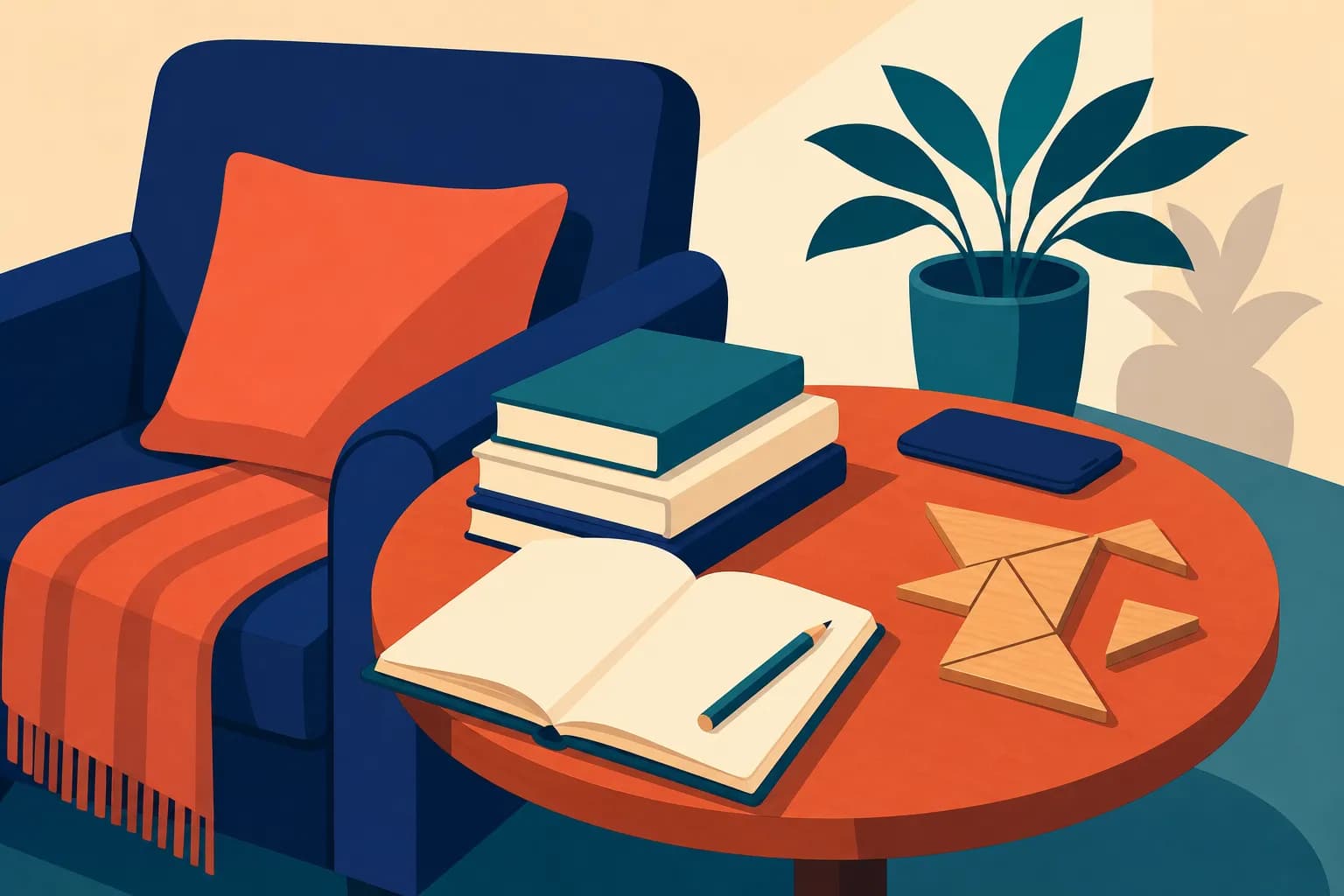
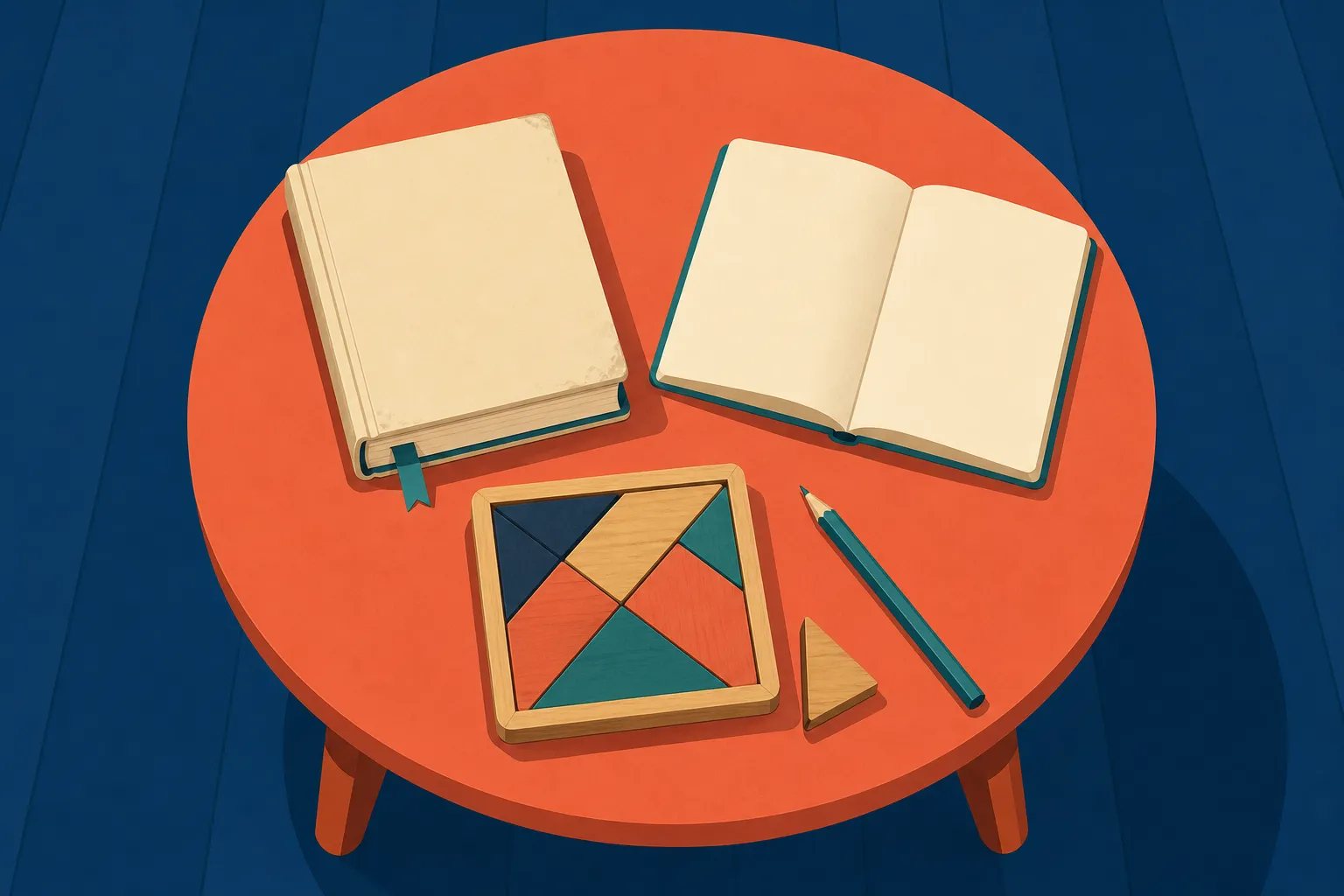
A book, a notebook, and a puzzle book beside the sofa: TikTok and Instagram users are putting together these sets so they can choose an offline activity instead of scrolling through their phone feed. The practice is called brain stacking. It may help you spend less time on your phone: having an alternative ready means you don’t have to come up with a replacement for scrolling every time.
For now, this is a plausible way to change a habit, but the method itself has not been proven effective. Descriptions of the trend are not backed by controlled studies of brain stacking, and claims that it can “restore the brain” go far beyond the available evidence.
What Is Brain Stacking?
Brain stacking involves a physical stack of accessible activities: books, a journal, sudoku, crosswords, or art supplies. You put them somewhere you tend to reach for your phone. The name refers to this stack, although you don’t literally have to pile the items on top of one another.
There are no fixed rules. You can read a few pages, solve one puzzle, or move freely from one activity to another. You don’t have to give up screens completely, buy a special kit, or follow a daily memory-training program.
The idea is to make it easy to choose something else instead of automatically opening your feed.
Why Having a Set Close at Hand May Change a Habit
Phones often beat other activities simply because they’re easier to start. They’re already nearby, while reading means choosing a book, finding it, and remembering where you left off. Drawing means looking for paper and pencils. Even small preparations can feel like one obstacle too many on a tiring evening.
A ready-made set cuts down on that preparation. It offers a clear cue to begin: the notebook is open, the pencil is nearby, and the book has a bookmark. The proposed mechanism is behavioral: the options become more accessible, and there are fewer decisions to make before taking action. This explains why the approach might work; it is not an established finding from research on brain stacking.
The alternative also needs to fit the situation. After a demanding day at work, a book of difficult puzzles may lose out to the feed, even if it’s in plain sight. A short story or a few unstructured doodles may be a better fit. Not every break needs to become an intellectual workout.
This approach is similar to digital minimalism: first decide what role technology should play in your life, then arrange your surroundings to support that choice.
You can put together a set using things you already own. The main thing is to make it easy to get started with the activity you choose.
What Research Says About Cutting Back on Scrolling
The closest study to the idea of having a ready-made alternative is research on the Wellspent app, published on April 8, 2026, in JMIR mHealth and uHealth. Participants chose an activity in advance to do instead of scrolling, such as reading or exercising. The app also used reminders, self-selected limits, and other settings.
The three-week randomized study included 70 iPhone users. Compared with the control group, the intervention reduced daily time spent in the selected problematic app by about 29 minutes. This is an encouraging result for the overall approach, but the study can’t tell us how much of the effect came specifically from choosing an alternative in advance.
Other studies help explain what to expect from reducing screen time. In a BMC Medicine study published in February 2025, 111 healthy students were assigned either to limit smartphone use to two hours a day for three weeks or to a control group. After the restriction, measures of sleep, stress, depressive symptoms, and well-being improved. Screen time then rose quickly and was close to its original level by the follow-up assessment. Two hours was a condition of the experiment, not a universal guideline.
At the same time, the benefits of digital limits vary. A meta-analysis of ten studies in Scientific Reports, published in March 2025, found no statistically significant effect of temporarily giving up social media completely on positive or negative emotions, or on life satisfaction. Giving up social media entirely is different from voluntarily replacing some scrolling, so this finding can’t be directly applied to brain stacking either.
For readers, there are two separate questions: will you spend less time on your feed, and will that make your life better? The first doesn’t guarantee the second. Neither these studies nor descriptions of the trend justify promising that a stack of puzzles will boost general intelligence or prevent dementia. The popular phrase “brain rot” is not a medical diagnosis either.
How to Put Together a Set Without Buying Anything
Start with one moment when you’re especially likely to pick up your phone: after dinner, while waiting, or before bed. Prepare an alternative specifically for that situation.
Choose two or three activities you already have at home or can borrow from a library. For example, a book with short chapters, a notebook, and a familiar puzzle.
Cut out unnecessary preparation. Put a pen in the notebook, mark your next page, and leave the materials where you’ll use them.
Decide on one simple action in advance: “After dinner, I’ll read a couple of pages first.” This is more specific than promising yourself, “I’ll spend less time on my phone today.”
Check whether the alternative works for you. If the book remains untouched, try a different activity or a different spot for your set. A beautifully arranged stack won’t solve the problem on its own.
You could observe for a week whether you’re opening your feed automatically less often and whether you enjoy the time you’ve freed up. Your chosen app’s usage statistics can offer another clue, but there’s no need to turn rest into a minute-by-minute competition.
If videos take up most of your breaks, it may help to look more closely at scrolling short videos. Perhaps in that moment you need entertainment, connection, or simply the chance to do nothing. The point of the set is to help you choose a kind of rest that suits you–not just to increase the number of pages you read.
Can I use an e-reader instead of a paper book?
Yes, an e-reader can serve the same role as an accessible alternative to the feed. A device that doesn’t put reading alongside notifications and social media may be especially convenient. The practice doesn’t require you to use paper only.
Do I need to switch activities every few minutes?
No. Brain stacking has no proven protocol with required intervals. If you’re absorbed in a book, you can keep reading. Having several options doesn’t mean you have to use them all in one evening.
How can I try brain stacking if I need to stay reachable?
Keep essential calls and messages available, and use your set instead of browsing the feed when it’s not necessary. You don’t have to put your phone away for a long time or turn off all communications. It can help to decide in advance which notifications genuinely need your attention.