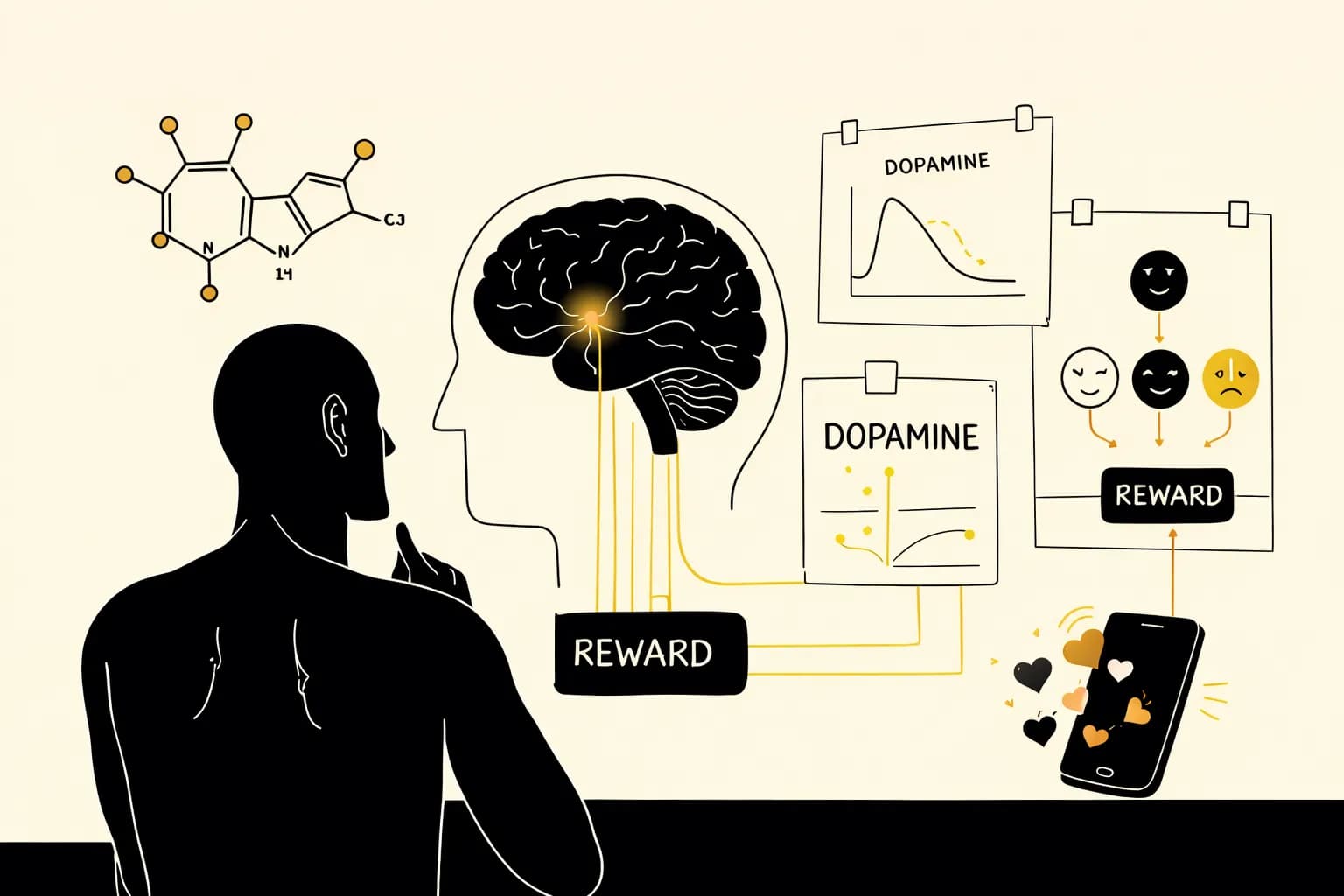
A Week-Long Dopamine Detox: How Attention Changes
What happens if you turn off notifications for a week and let the brain forget instant rewards? We explore the dopamine mechanism and the first days of detox.

⋄4 min read

You grab a can of sugar-free soda after lunch — almost no calories, a sweet taste, and a clear conscience. Half an hour later, you find yourself standing by the cookie machine. Is it a coincidence, or did the sweetener really “rev up” your appetite?
Short answer: no, sweeteners do not change cravings for sweets in exactly the same way as sugar. Sugar provides energy and raises blood glucose; intense sweeteners mainly provide a sweet taste. But for some people, a sweet taste without calories can reinforce the habit of seeking dessert — especially if a zero-sugar drink has become a daily companion to snacks.
Sweeteners, or sugar substitutes, are a general term for substances with a sweet taste that are used instead of sugar. This category includes very different products: sucralose, aspartame, saccharin, stevia, as well as erythritol and xylitol. Treating them as identical would be too simplistic: they differ in composition, dosage, calorie content, and how they are tolerated by the gut.
The tongue tells the brain: “sweet.” Sugar adds a continuation to this message from the gastrointestinal tract: glucose enters the bloodstream, insulin levels change, and the body gains access to readily available energy. A sweetener usually does not provide this continuation, or provides very little of it.
This is where confusion often arises. A sugar-free drink can help reduce calories if you drink it instead of a sugary soda. This is a practical swap: a glass of sugar-sweetened cola disappears from the diet, while the familiar ritual remains. Another situation is when the drink is added to your usual diet and serves as a signal: “now I can have something tasty.”
Cravings for sweets are not purely physiological. They include the four-o’clock slump, the smell of baked goods near the subway, the habit of ending dinner with chocolate, and an attempt to find quick comfort after an unpleasant conversation. The same sweetener can play a completely different role in two people’s lives.

A study by a team led by Kathleen Page of the University of Southern California, published in Nature Metabolism in 2025, sparked a new wave of discussion. On different days, participants drank a beverage with sucralose, a beverage with sucrose, or water; researchers compared self-reported hunger, blood tests, and functional MRI results.
After sucralose, the researchers observed a stronger hypothalamic response than after sucrose. This region is involved in regulating hunger and energy balance. Sucrose, meanwhile, caused the expected changes in glucose and hormonal signals associated with eating, while sucralose did not. The differences appeared more pronounced in some participants, particularly women and people with obesity.
This is an interesting result, but it would be dishonest to conclude from it that “sucralose makes everyone overeat.” The experiment examined an acute response after individual drinks, not people’s diets over many years. It studied sucralose, not stevia, erythritol, or every product labeled “sugar-free.” And activity on an MRI scan is not a verdict on your eating habits.
Sweet taste can be a useful bridge from excess sugar to a calmer diet. The problem begins when the bridge turns into an endless cycle of snacking.
The brain remembers associations. Coffee — cookies. A TV series — ice cream. The journey home — a sweet bar. If you wash down dessert with a sugar-free soda every time, the drink’s flavor becomes part of the familiar pattern. It does not have to create hunger physiologically to trigger desire: sometimes a familiar context is enough.
There is also a simpler explanation: a person deliberately “saves” calories during the day and allows themselves a large portion in the evening. The sweetener is not the culprit here, but a participant in an internal bargain. These bargains often happen without being clearly articulated: “I chose the light drink, so I can have the fries.”
Compare the effects separately, and the question of sugar substitutes becomes much clearer.
What you drink or eat | Calories and glucose | Sweet-taste signal | What may happen to appetite |
|---|---|---|---|
Sucrose: lemonade, syrup, candy | Contains calories; glucose usually rises | Pronounced | Pleasure and energy at first, followed by possible renewed hunger — depending on the portion and accompanying food |
Intense sweetener: sucralose, aspartame, saccharin | Usually almost no calories or effect on glucose | Pronounced | For some, it helps reduce the desire for sugar; for others, it reinforces the urge to “complete” the sweet taste with food |
Erythritol or xylitol | Erythritol provides almost no energy; xylitol is higher in calories | Milder than sugar | Satiety depends more on the dish itself; a large portion may cause bloating or loose stools |

A sweetener can be a convenient temporary tool. For example, you may be used to drinking two sugary sodas a day and switch to one sugar-free version while replacing the other with water and lemon. Your taste preferences adapt gradually; for many people, after several weeks their former sugary soda tastes overly sweet.
In 2023, the World Health Organization issued a conditional recommendation against using non-sugar sweeteners as a long-term strategy for weight control or reducing the risk of chronic disease. The wording is specifically conditional: it does not ban sweeteners or turn a can of zero-sugar soda into a dangerous product. WHO suggests taking a broader view — reducing the overall habit of consuming very sweet flavors and improving the diet as a whole.
There are situations in which sugar-free sweet drinks make particular sense: someone finds it difficult to give up a familiar taste immediately, is reducing added sugar, or wants to preserve a pleasurable experience during an occasional café visit. A rigid “no” often ends in a lapse and extra guilt.
The fact that you enjoy stevia in your coffee says nothing about an addiction to sweets. It is worth paying attention when taste stops being a choice and begins to control your day. Consider whether any of these observations apply to you:
You buy sweets automatically almost every day and only notice it at the checkout.
After a sugar-free drink, you find it difficult not to look for a candy, pastry, or chocolate.
Ordinary foods — berries, plain yogurt, tea — seem “tasteless” without intense sweetness.
You skip a proper meal and compensate for hunger in the evening with dessert.
The thought of giving up sweet drinks for a week causes anxiety or irritation.
You eat sweets secretly, then feel ashamed and promise yourself strict restrictions.
If you recognize yourself in several of these points, you do not need to throw all sweets out of the house. Start with one recurring episode. For example, keep your usual coffee, but for three days postpone the sweet snack by 20 minutes and eat proper food first: cottage cheese, an egg with bread, soup, or a handful of nuts with fruit. This makes it easier to see whether it was hunger or a ritual.
For two weeks, try treating sweeteners as a tool rather than a salvation or a threat. Choose one product — say, your morning coffee or an afternoon soda — and do not change everything else at the same time.
Write down when the desire for sweets appears: the time, your hunger level on a scale from 0 to 10, and your mood.
If you choose a product with a sweetener, eat or drink it after a full meal rather than on an empty stomach.
For seven days, remove the sweet taste from one familiar ritual. Instead of a second can of zero-sugar soda, choose cold water, tea, or sparkling water with a slice of citrus.
Do not compensate for the experiment with prohibitions. You can eat dessert mindfully, sitting at the table without your phone.
At the end, compare not your weight but the frequency of intrusive thoughts about sweets and your hunger level before dinner.
If cravings become distressing, food causes anxiety, or regular episodes of overeating or purging occur, it is more useful to discuss this with a psychotherapist or doctor who works with eating behavior. At that point, an argument about the ingredients in soda is unlikely to help much.
Most intense sweeteners, when consumed in ordinary amounts, do not raise glucose in the same way as sugar. Check the ingredients of the specific product: a drink or dessert may contain juice, syrup, flour, and other carbohydrates.
Stevia and sucralose differ in origin and flavor profile, but there is no universal winner. Choose the option that does not cause unpleasant effects and helps you reduce added sugar without subsequently compensating with food.
The desire to eat may arise from the familiar association “sweet taste — dessert,” genuine hunger, or an expectation of reward. Try drinking it after a satisfying meal and compare your response with drinking it on an empty stomach.
Yes, if zero-sugar soda replaces sugary, high-calorie drinks and does not lead to regular additional snacking. The drink itself does not create an energy deficit: what matters is your overall diet and how sustainable it is for you.
Erythritol provides a sweet taste and may therefore reinforce a habit of eating sweet products in some people. It usually has less effect on blood glucose, but large amounts can cause abdominal discomfort.
Contact a doctor or psychotherapist if food causes severe anxiety, you regularly overeat with a loss of control, purge after eating, or severely restrict your diet. These symptoms require compassionate professional support, not another diet.
How was this article?
Share