We all sometimes admire our reflection in the mirror or take pride in our achievements. But what happens when this need for admiration becomes a dominating trait of the personality? Let’s dive into the complex and often painful world of narcissism — not to condemn, but to understand.
What is a narcissistic personality?
Imagine a person who lives as if on a stage, where he is always the main character, and everyone else is merely spectators or extras. A narcissistic personality is not simply an inflated self-esteem or confidence. It is a deep need for constant affirmation of one’s own significance that governs the entire life of the person.
Behind the mask of grandeur often lies frightening fragility. These people are like porcelain vases — they look impressive and expensive, but the slightest hit of criticism can shatter them into pieces. And it is this inner fear that makes them build ever higher walls of superiority.
History of study: from myth to science
The term "narcissism" takes its name from the ancient Greek myth of Narcissus, a youth who fell in love with his own reflection. But the scientific understanding of this phenomenon began much later.
Sigmund Freud first introduced the concept of narcissism in psychoanalysis in 1914, describing it as a stage of normal development. Later, Heinz Kohut in the 1970s revolutionized the understanding of narcissism, creating the theory of "self psychology." He showed that narcissistic traits are formed as a defense mechanism in the absence of empathy from significant adults in childhood.
Otto Kernberg developed another approach, viewing narcissism through the lens of object relations. According to his research, Narcissistic Personality Disorder (NPD) was officially included in the DSM-III in 1980.
Statistics that make you think
According to the National Institute of Mental Health (USA), narcissistic personality disorder affects 0.5% to 1% of the general population. That may seem like a small figure, but if you consider subclinical forms of narcissism, the rates increase dramatically — up to 6% of the population show pronounced narcissistic traits.
Interesting fact: men receive this diagnosis 2-3 times more often than women. A study published in the Journal of Clinical Psychiatry in 2008 showed that the average age of onset of the disorder is early adulthood (20-30 years).
A concerning trend in recent years: research from the University of San Diego (Twenge & Campbell, 2009) showed a 30% increase in narcissistic traits among the youth between 1982 and 2009. The culture of social media seems to create fertile ground for the development of narcissistic patterns.
Types of narcissistic personalities
Grandiose (open) narcissism
These are the ones who are easiest to recognize. They enter a room, and everyone instantly feels it. A loud voice, extravagant stories about their own successes, constant dominance in conversation. Such people openly display their superiority, demand admiration, and do not hide their grandiosity.
Vulnerable (covert) narcissism
This is a more insidious type. Imagine a person who constantly plays the victim but is confident in their specialness. They are hyper-sensitive to criticism, avoid situations where they might appear imperfect, yet inside they are convinced of their uniqueness. Their superiority is manifested through suffering: "No one understands how hard it is for me, because I am special."
Malignant narcissism
The most troubling type, combining narcissistic traits with antisocial behavior, paranoia, and aggression. These people can be manipulative, cruel, and lacking in compassion. They derive pleasure from control and causing pain to others.
How is narcissistic personality formed?
The story of every narcissist begins in childhood. And it is always a story of pain, even if everything looked fine on the surface.
Emotional deprivation
A child who did not receive enough unconditional love and acceptance begins to create a false "Self" — an ideal version of themselves that they think deserves love. Studies show that children of emotionally cold parents develop narcissistic traits three times more often.
Excessive idealization
Paradoxically, the opposite extreme leads to the same result. When parents praise a child for every step without teaching them a real assessment of their abilities, an inflated but fragile ego forms. The child becomes accustomed to constant admiration and does not learn to cope with ordinary life disappointments.
Traumatic experience
Violence, humiliation, rejection in childhood can force a child to build a powerful psychological defense. Narcissism becomes armor: "If I am perfect and superior, no one will be able to hurt me again."
Signs of narcissistic personality
Grandiose self-perception
A person sincerely believes in their exceptionalism. They not only want to be the best — they are sure they already are, even without objective grounds.
Fantasies of unlimited success
Constant dreams of power, beauty, wealth, perfect love. These fantasies are so vivid that they often replace real life.
Need for constant admiration
This is not just a desire — it is a real addiction. Without a regular "dose" of praise and admiration, the narcissistic personality feels emptied.
Lack of empathy
The most painful sign for those around them. The person is unable to sincerely understand and share others’ feelings because they are completely absorbed in themselves.
Exploitation of others
People are perceived as tools to achieve goals or sources of admiration. Relationships are superficial and serve only to satisfy narcissistic needs.
Envy and belief in others’ envy
The narcissistic personality either painfully envies others or is sure that everyone is envious of them.
How to identify narcissistic personality?
Clinical diagnosis is performed by a qualified specialist using structured interviews and standardized questionnaires, such as the Narcissistic Personality Inventory (NPI) or Pathological Narcissism Inventory (PNI).
The diagnosis is made when at least five of nine DSM-5 criteria are present, which must manifest stably in various situations and significantly impair the person’s functioning.
It is important to understand: narcissistic traits are present in many people, but a personality disorder is a qualitatively different level where these patterns dominate and ruin the life of the person and their surroundings.
The cycle of relationships with a narcissist
The cycle of relationships with a narcissist is almost always repetitive. It is not chaotic — it is structured, predictable, and exhausting.
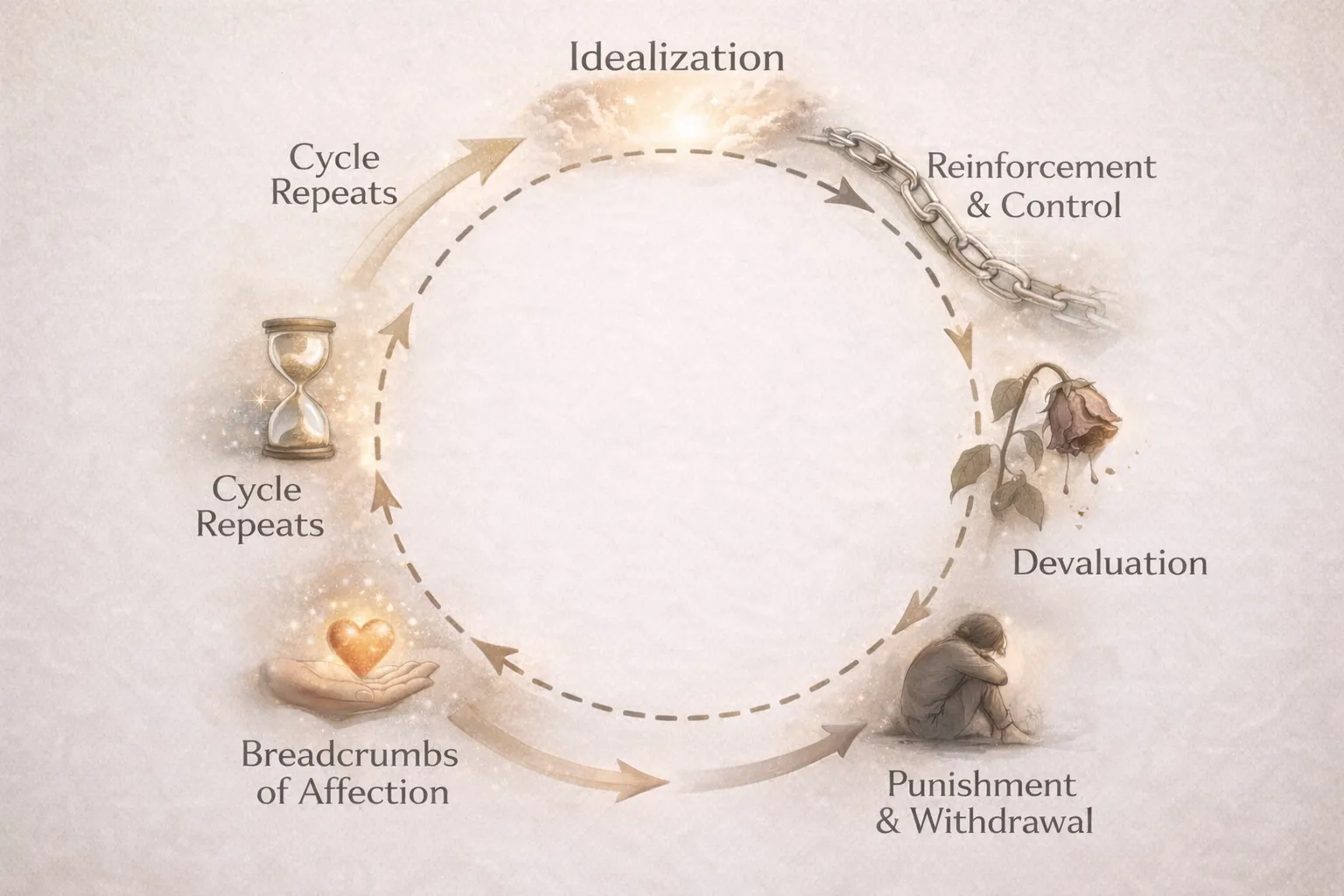
1. Idealization (love bombing)
You are “special,” “the only one,” “finally someone real.”
Intense closeness instead of genuine intimacy: rapid closings, promises, emotional push.
Your value is a reflection of their grand image.
Psychologically: the narcissist “feeds on” admiration; you are a source regulating their self-esteem.
2. Consolidation and control
Dependence forms: emotional, sometimes financial or social.
Boundaries blur: “we are one,” “you won’t cope without me.”
Jealousy, devaluation of your connections, subtle manipulations.
Psychologically: fear of abandonment is masked by control.
3. Devaluation
What they once adored becomes a reason for criticism.
Gaslighting: you are “too sensitive,” “you’re making it all up.”
Coldness, passive aggression, comparison with others.
Psychologically: your autonomy threatens their fragile self.
4. Punishment / withdrawal
Ignoring, disappearing, emotional freezing.
You begin to “deserve” warmth.
Guilt and shame become fixed.
Psychologically: he restores a sense of power.
5. Shards of warmth (hoovering)
Sudden tenderness, remorse, promises of change.
Return to idealization — but shorter and weaker.
You hope that “this time it’s for real.”
Psychologically: a dopamine loop, similar to an addiction.
6. Repetition of the cycle
Each round is shorter, colder, and more painful.
Your self-esteem falls, self-doubt grows.
He remains at the center, you at the periphery.
Treatment and control strategies
The main and most effective method is long-term psychotherapy. Here are the main approaches:
Psychodynamic therapy helps explore the roots of narcissism in childhood experiences. The therapist creates a safe space where a person can gradually release protective mechanisms and confront their vulnerable, true "Self." This is a painful process that requires several years of work.
Schematherapy has shown especially good results. It helps identify maladaptive schemas formed in childhood and replace them with healthier ways of perceiving oneself and others.
Cognitive-behavioral therapy (CBT) focuses on changing specific thought patterns and behaviors. The person learns to recognize automatic narcissistic thoughts and replace them with more realistic ones.
Mindfulness therapy develops the ability to understand one’s own and others’ mental states, which is critically important for developing empathy.
Medication
There are no specific drugs for treating NPD. However, medications can help manage comorbid conditions — depression, anxiety, which often accompany narcissism. Antidepressants or mood stabilizers are prescribed individually.
Group therapy
After some progress in individual work, group therapy becomes a powerful tool. In a safe group environment, a person learns to receive feedback, develops empathy, and practices healthier ways of interacting.
Self-control strategies for people with NPD
Developing self-awareness
Keeping an emotions diary helps track narcissistic reactions. When you feel anger from criticism or an overwhelming need for admiration — write it down. Awareness is the first step to change.
Practice of empathy
Start small: when someone speaks about their feelings, pause and ask yourself: "What might this person feel?" Do not judge, just try to understand. It’s like training a muscle — at first it’s hard, but over time it becomes more natural.
Working with criticism
Instead of automatic defense, try a “pause” technique: hear the criticism — take a 10-second pause, take a deep breath, ask yourself: "Is there any rational basis to this?" You don’t have to agree with everything, but try to consider another viewpoint.
Setting realistic goals
Learn to set achievable goals and accept imperfection — in yourself and others. Practice the phrase: "I did this well, though not perfectly, and that’s fine."
Mindfulness and meditation
Mindfulness practices help reduce reactivity and learn to observe thoughts without automatically following them. Even 10 minutes a day can substantially improve self-control.
Forecast and hope
Narcissistic personality disorder is one of the most challenging conditions to treat, primarily because people rarely seek help on their own. But change is possible. Research shows that with age (after 40-50 years), narcissistic traits often soften naturally.
The main thing is the resolve to work on oneself and the willingness to go through the discomfort of facing a real, vulnerable "Self." Behind the mask of grandeur hides a frightened child who did not receive enough love. And it is this child that needs healing.
The path to change begins with one small step — acknowledging that behind the shield of superiority there may be something more authentic and valuable. And this acknowledgment requires real courage.