Your subconscious is a vast ocean, and consciousness is only a small island on its surface. Most of the time we live on this island, not even suspecting what treasures and secrets lie in the depths. Carl Gustav Jung, a Swiss psychiatrist and one of the founders of depth psychology, created a remarkably simple yet powerful tool for exploring these depths—the method of 16 associations.
Why does this work
At the core of the method is the understanding that our subconscious holds answers to many questions that trouble us in everyday life. When we try to solve a problem logically, we often go in circles, returning to the same thoughts. But let the subconscious speak—and it provides us with unexpected insights we never suspected.
Jung believed that free associations are a bridge between the conscious and the unconscious. When we do not control our thoughts, do not try to look clever or correct, that is when true feelings, fears, and desires surface.
How the method works: step-by-step instructions
The method looks deceptively simple, but within this simplicity lies its power. You only need a sheet of paper, a pen, and 15-20 minutes of calm time.
Step 1: Choose a problem
Formulate what worries you in one word or a short phrase. It could be "work", "relationship with my mother", "fear", "loneliness" or "money". It is important to choose something that truly resonates inside, that evokes an emotional response.
Step 2: First level — 16 associations
Write your cue word in the center of the page. Now quickly, without overthinking, write 16 association words that come to mind. Do not analyze, do not censor yourself. If the word "fool" or "hatred" comes up—write it. There are no right or wrong answers here.
Step 3: Second level — deepening
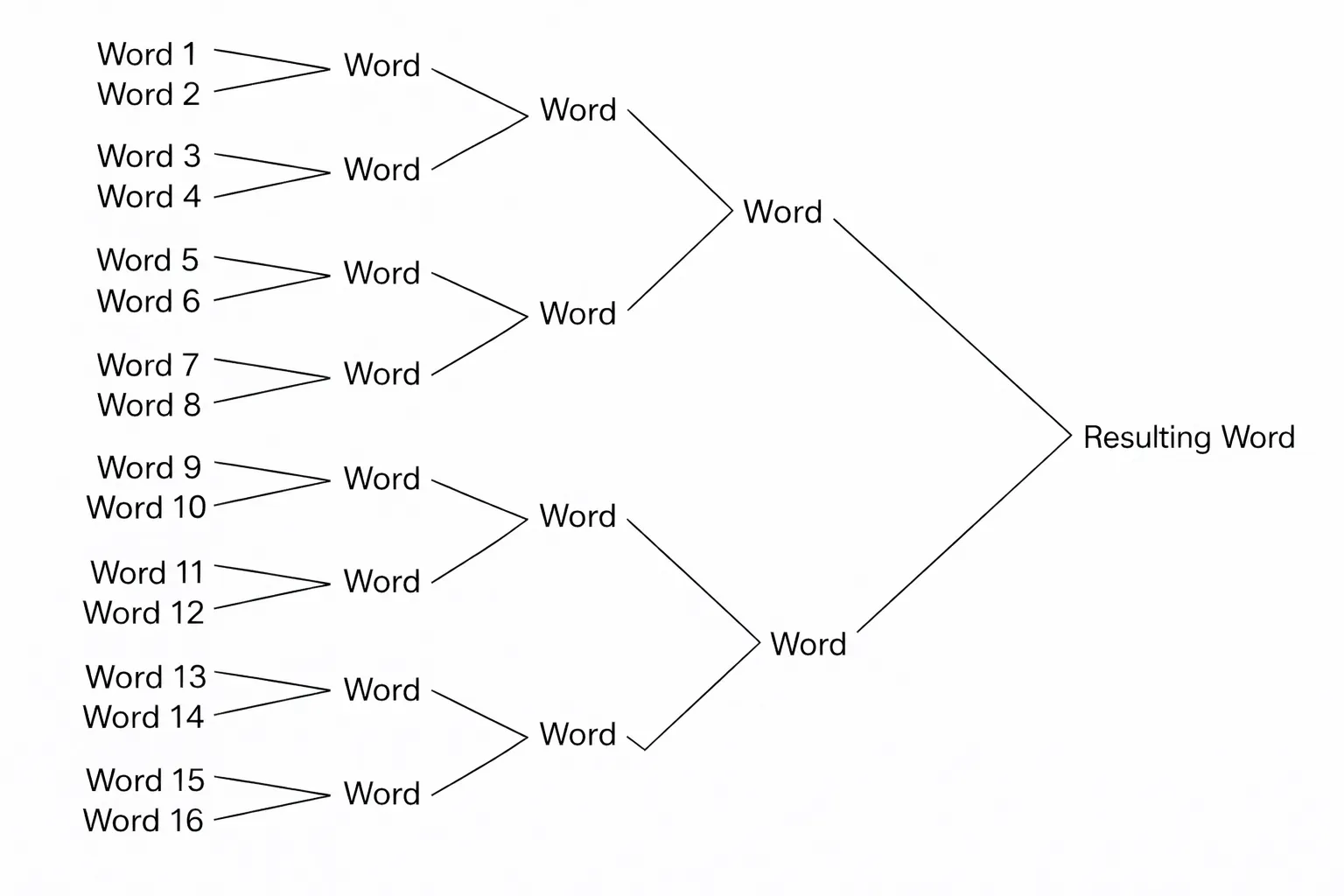
Now take each of the 16 words and for each, pick one more associated word. You will have 16 new words. At this stage, the subconscious begins to reveal itself more deeply.
Step 4: Third level — pairwise combination
Here begins the most interesting part. Combine your 16 second-level words in pairs and for each pair choose one common association. You will get 8 words.
Step 5: Fourth level — narrowing
Continue the process: combine 8 words pairwise to obtain 4 new associations.
Step 6: Fifth level — final narrowing
From 4 words, make 2.
Step 7: Result
The last two words are combined into one final word-result. This is the answer of your subconscious.
Analysis of levels: what each layer of associations means
Understanding the structure of the levels is the key to deep work with the method. Each level reveals a certain layer of our psyche, and it is important to learn to distinguish them.
First level (16 words): social mask
This is the most superficial layer. Here live our habitual thoughts, stereotypes, what we are used to thinking about the problem. If you wrote the word "work", the first associations might be: "office", "boss", "salary", "fatigue". These are logical, predictable connections. They reflect how we are used to thinking about the problem at the conscious level.
Often at this level we see socially acceptable words—what we are not ashamed to utter aloud. This is our "public" version of the problem.
Second level (16 words): emotional layer
When we make associations to associations, more personal things begin to surface. Here there is less logic and more feelings. For the word "boss" the association "father" might surface, for the word "fatigue" — "powerlessness".
At this level defenses weaken. We begin to touch what we really feel, not what is "supposed" to be felt. It is here that unexpected connections often arise, making us stop and think: "Why did I write this?"
Third level (8 words): hidden patterns
When we pair words, magic of synthesis happens. Our brain starts looking for commonalities between seemingly different things. This level reveals recurring themes of our life, our inner conflicts.
Perhaps several pairs will lead you to words about control, or fear, or a need for recognition. These patterns are like red threads running through our entire life, but we usually do not notice them.
Fourth level (4 words): the core of the problem
Here we approach the essence. Four words at this level often reflect basic needs or fears. This could be "security", "love", "freedom", "acceptance". We move from the concrete to the universal, from the symptom to the cause.
At this level, it becomes clearer what our problem is really about. Perhaps a conflict at work is not about the work itself but about the need for respect or the fear of being rejected.
Fifth level (2 words): duality
The two final words often represent opposites or two poles of one conflict. This could be "freedom — security", "love — fear", "control — trust". This duality shows the internal conflict that underlies the problem.
Realizing these two poles is therapeutic in itself. We begin to understand that there is a struggle inside us, and both sides have a right to exist.
Final word: essence
The last word is the quintessence of the whole process. Sometimes it comes as an insight, sometimes as confirmation of what we vaguely felt. It is the subconscious's answer to the question with which we started.
This word can be surprising. You started with "work" and ended with "loneliness" or "self-hatred". It is in this gap between the initial formulation and the final result that the insight lies.
Practical example: when the method changes life
I recall a case with my client Olga. She came with the problem of "constant conflicts with her husband". The first level yielded predictable words: quarrel, shouting, resentment, misunderstanding. But when we reached the final word, it turned out to be — "mother".
Olga started to cry. She realized that she was reproducing her parents' relationship pattern, and all conflicts with her husband were an attempt to replay a childhood trauma where she could not protect her mother from her father’s shouting. Recognizing this connection became the beginning of a deep transformation in her family.
Important nuances of working with the method
When working with this method, remember a few things. First, do not rush. Give yourself time to immerse in the process. Second, be honest with yourself. If an "indecent" or frightening word surfaces—write it down. It is precisely there that the key to the solution may be hiding.
Third, do not try to interpret the words logically during the process. Analysis comes later, once the entire chain is built. And finally, trust the process. Even if the result seems strange or not related to the problem—give it time to mature in your consciousness.
When the method is especially effective
The 16 associations method works best when we are stuck on a problem and see no way out. When logic does not help, when we go in circles returning to the same thoughts. It is especially useful for working with repeating behavioral patterns, with unexplained anxiety, with decisions we cannot make.
Many of my clients use this method as a regular practice of self-knowledge. Once a month they take a current topic and work through it with associations. This helps not to accumulate emotional burden and to notice in time what happens in the depths of the psyche.
Limitations and caution
Despite its effectiveness, the method is not a panacea. If you are dealing with a serious trauma, deep depression, or an anxiety disorder, it is better to work with the method under a psychologist’s guidance. Some associations may open painful memories that are hard to cope with alone.
Also the method requires a certain psychological readiness to meet your true self. We are not always ready to see what lies in the depths. And that is normal. Move at your own pace, respect your boundaries.
Conclusion: your personal guide
The 16 associations method is not just a psychological technique. It is a way to establish a dialogue with the wisest part of yourself, with the part that knows the answers but rarely gets a chance to speak. In our world, flooded with information and other people’s opinions, it is crucial to have a tool that brings us back to our own truth.
Try it right now. Take a sheet of paper, choose what concerns you, and start writing. Do not think, do not analyze—just let the words flow. Perhaps in 20 minutes you will see your problem in a completely new light. Or perhaps you will find a solution you have been seeking for months. Your subconscious already knows the answer. You just need to give it a chance to speak.