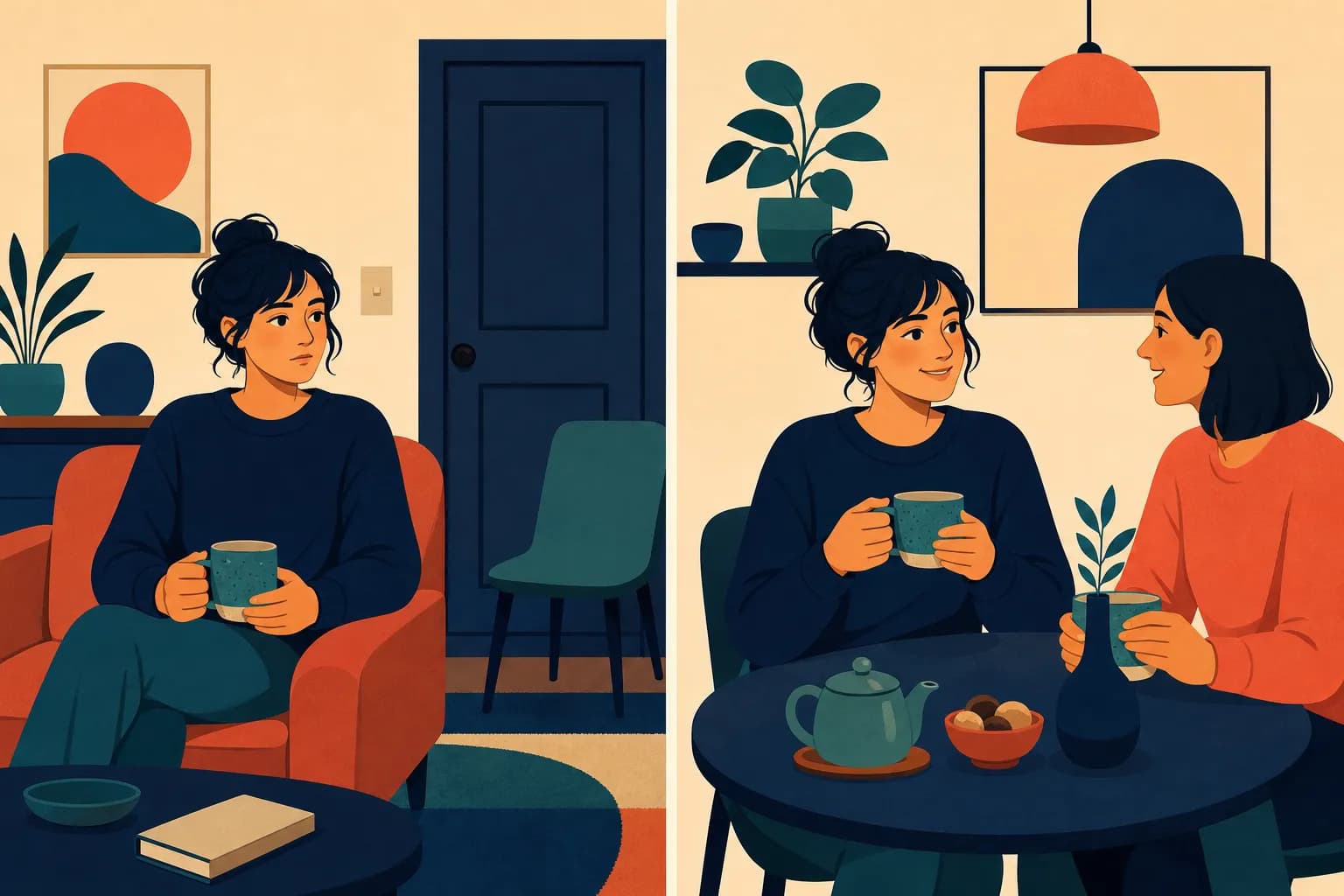
Female Archetypes Amazon and Puella: Do You Fight or Dream?
Published on: ⋄5 min read
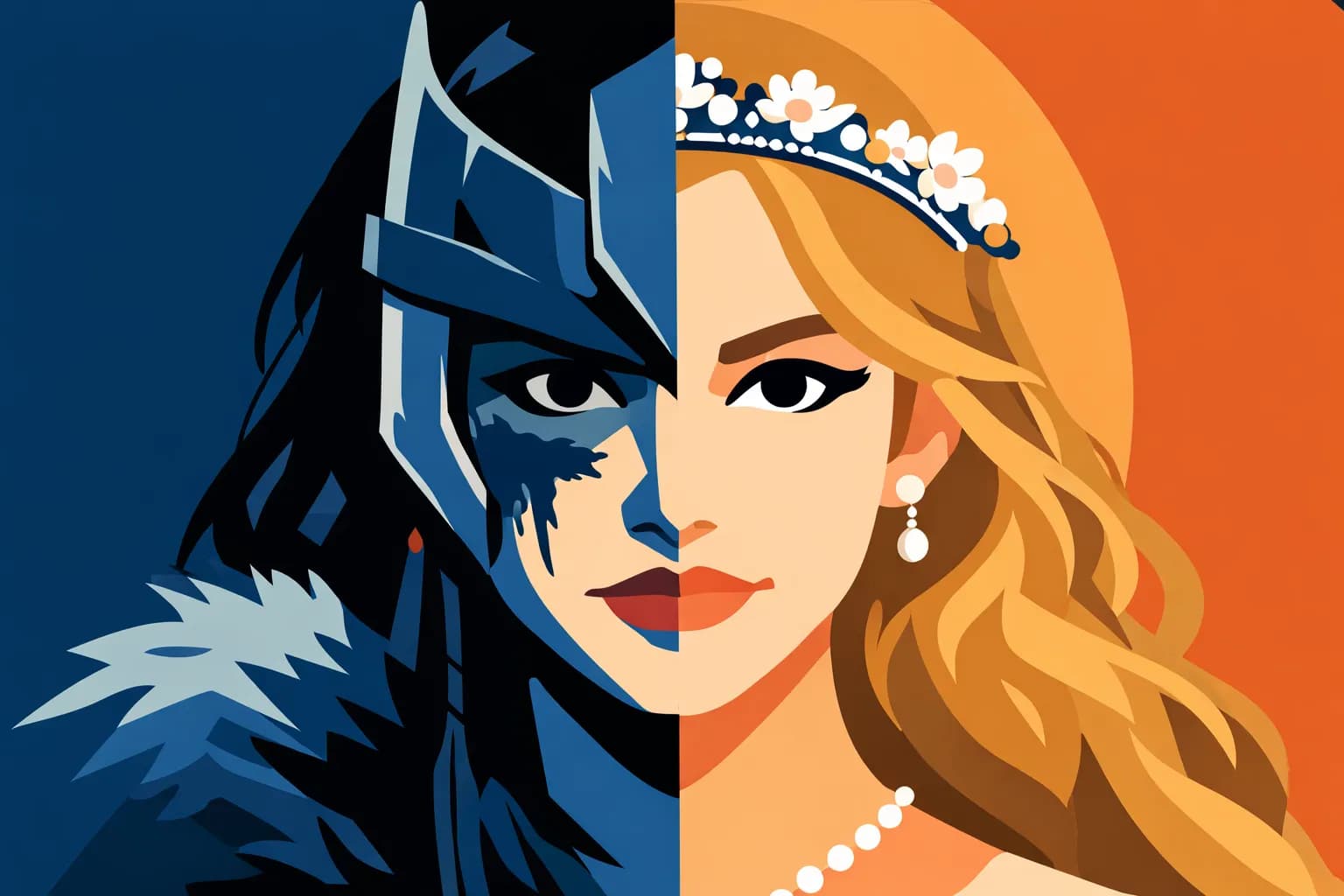
In Jungian psychology there is a classification of women described through archetypes. Today we'll talk about two of them: the Amazon and the Puella. About how they manifest, how they can be dangerous in extremes — and why we need both.
Amazon: she who is her own warrior
The Amazon is the archetype of the woman-warrior. Independent, purposeful, capable of standing up for herself and for those she loves. Her name comes from Greek myths, where a tribe of female warriors lived without men, hunted, fought and ruled their own world.
In modern life the Amazon is a woman who:
builds a career with the same seriousness as the men around her;
doesn't wait for someone to decide things for her;
knows how to set boundaries — clearly, without apologies;
is comfortable alone and not afraid of solitude;
acts where others are still only thinking.
Her strength is clarity. She knows what she wants and goes for it. She does not dissolve into relationships and does not lose herself for love. She respects herself — and that is precisely why she elicits respect from others.
Shadow of the Amazon
But every archetype has a shadow — what it becomes when it becomes the only life strategy.
The Amazon in shadow is a woman who has forgotten how to ask for help. Who sees vulnerability as weakness, and tenderness as danger. She keeps everything under control because deep down she is afraid: if she lets go — everything will collapse. Or — even worse — she may find that without her armor she doesn't know who she is.
She can be successful and yet incredibly lonely. Relationships with her often reach a dead end: there is nothing for the partner to latch onto, nowhere to come. Everything is already done, everything is closed, help is not needed.
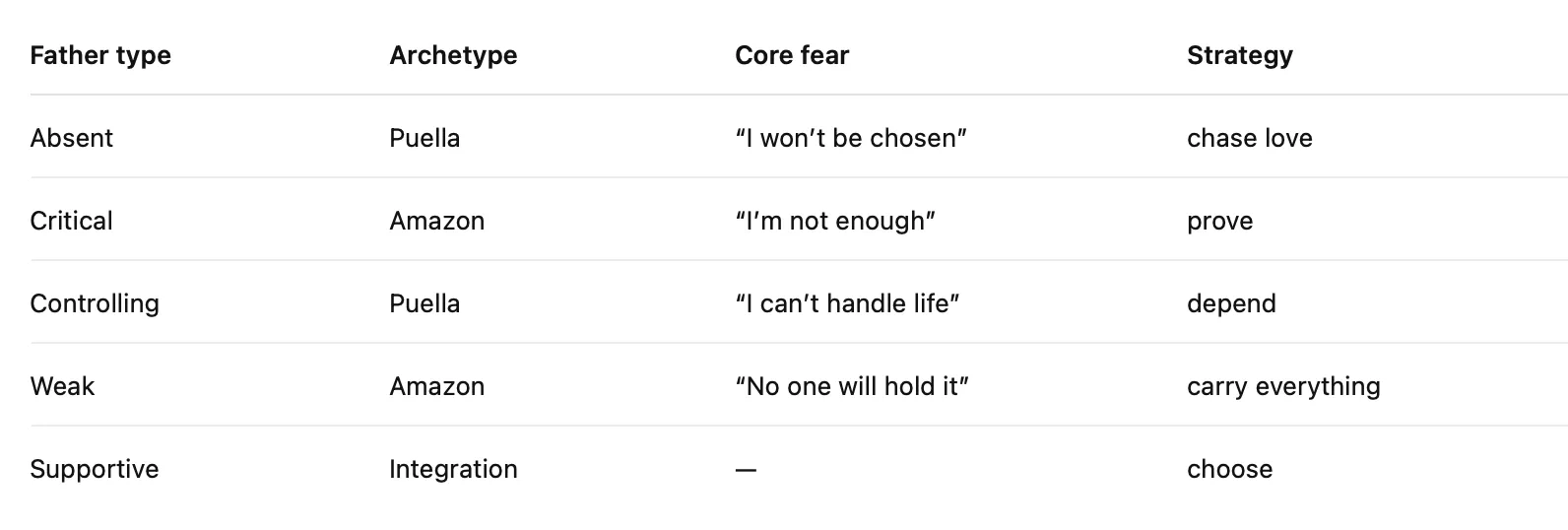
The paradox of the Amazon: the more she defends herself, the more she isolates herself from what she actually longs for — true intimacy. Often such a life strategy is formed because of a weak father figure or, on the contrary, a very despotic and critical one. When a girl forms the belief “I am not enough” or “I must do everything myself.”
Puella: the eternal girl
“Puella” from Latin simply means “girl.” In Jungian psychology this archetype describes a woman who lives in a state of eternal youth — inner, not outer. She is the Puella Aeterna, the eternal maiden.
The Puella perceives the world through images, feelings and possibilities. She dreams, falls in love, gets inspired.
Her traits:
a rich inner world, a well-developed imagination;
subtle emotional sensitivity — she feels people and the atmosphere;
a creative nature: she generates ideas, images, meanings;
openness and vitality — being near her makes it easier to breathe;
the ability to fall in love — with people, with projects, with life.
The Puella believes in miracles and knows how to create them. Where the Amazon sees a task — the Puella sees an adventure.
Shadow of the Puella
The shadow of the Puella is an escape from reality. When the eternal girl does not grow up.
In shadow she avoids responsibility, hides from conflicts, waits for someone else (a prince, circumstances, the universe) to come and fix everything. She starts many things but finishes few — because endings require effort, not just inspiration.
Often the Puella doesn't have her own money and doesn't know how to earn it. From her infantile position she expects someone to take responsibility for her. Relationships repeat according to one script and are in most cases codependent. They often choose a despotic man, seeing in him a strong male figure. Talents remain unrealized — because to "realize" means to choose, to commit, to take on the work.
In the case of the Puella the life script is formed because of a critical or absent father. They "chase and earn love" or are heavily dependent on a man's opinion.
Type of father and female archetype
They need each other
An Amazon without a Puella is a warrior without lightness. Effective, but for what? She achieves — but sometimes looks back and doesn't understand why there is emptiness inside.
A Puella without an Amazon is a dream without wings. There are images, there are desires, but no embodiment. Because embodiment requires strength, which must be drawn from somewhere.
True female maturity is not a choice between them. It is integration.
When the Amazon learns to let go of control and allows herself to be tender — she does not become weaker. She becomes whole. When the Puella finds the strength to finish what she started and to meet reality without fleeing — her magic does not disappear. She lands. And that is when she becomes real. If you look at this through the prism of the relationship with the father, then from childhood the integration of the two archetypes is formed with a supportive and involved father.
How to understand which archetype dominates you?
A few questions for reflection:
If the Amazon dominates you:
— When was the last time you allowed yourself not to know the answer?
— Are there people around you whom you allow to care for you?
— What do you want — not as someone who has to cope, but simply as a person?
If the Puella dominates you:
— Is there something you've wanted for a long time but keep postponing "until a better moment"?
— What will happen if you choose one direction and go all the way?
— Who will you become if you're not afraid to disappoint yourself?
Conclusion
Archetypes are maps that help reveal where we are stuck, where our blind spots are, where unrealized potential lies.
The Amazon and the Puella live in each of us — in different proportions, at different periods of life. It's important to recognize whether there isn't an imbalance toward one of the archetypes and to learn to integrate and use both in particular life situations. Sometimes we need the warrior. Sometimes — the one who knows how to be amazed. Wisdom is knowing who is needed when.