Working with the shadow side of the personality that people don't talk about
Published on: ⋄5 min read
A person's spiritual growth is a continuous process of refining the self and searching for inner truths. But sometimes growth feels not like light, but like losing your footing. Often it's not about an easy path to mindfulness, but a thorny path of transformation.
As if you've become 'more mindful', but inside — there's more tension, more anger, more truth that used to be easier to ignore.
This is where what Carl Gustav Jung called shadow work begins.
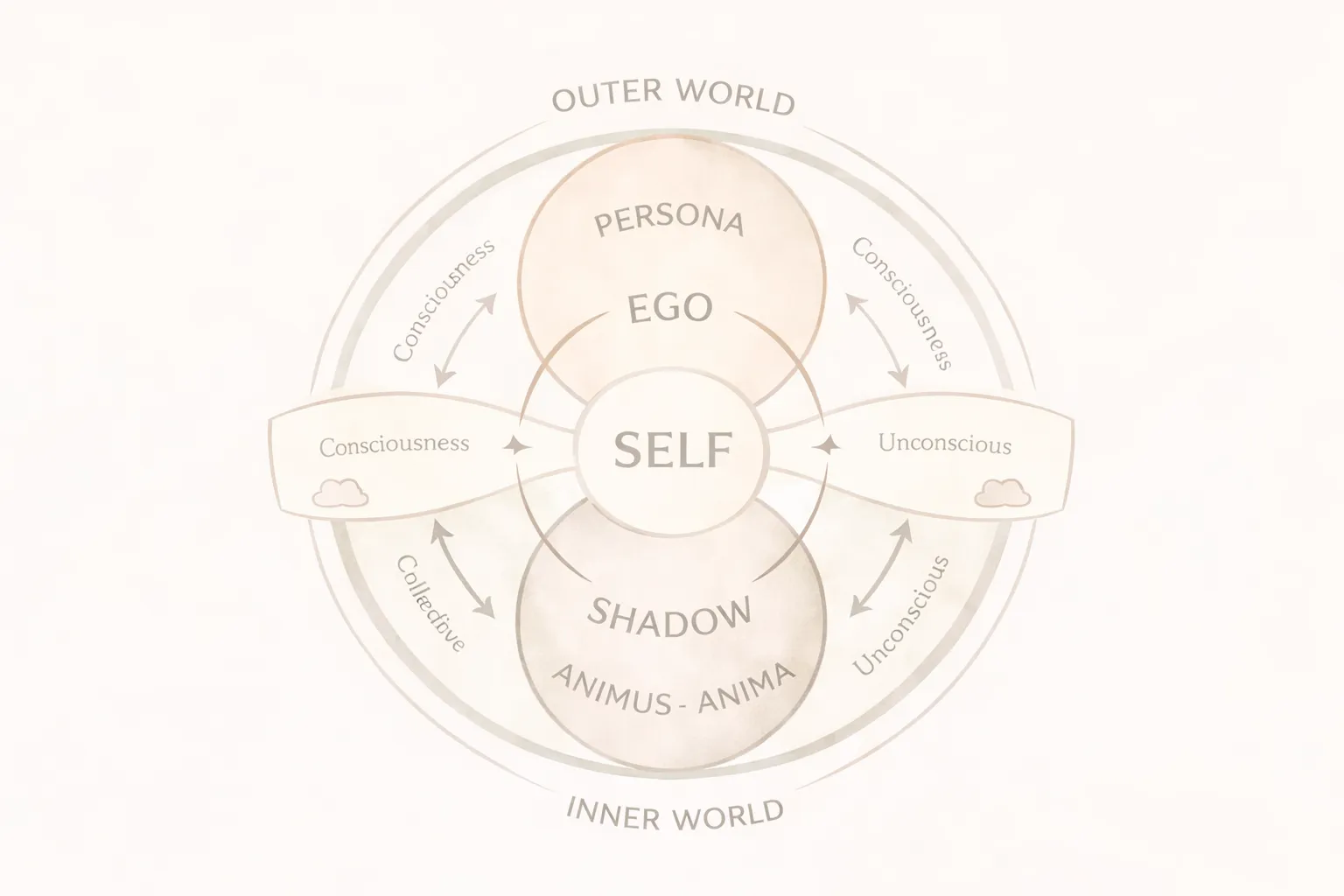
Model of Carl Jung's psyche
The shadow side they don't warn you about
In popular culture, spiritual growth is about calm, acceptance, love, "high vibrations." But the real process is closer to unpacking what was repressed.
Our ego forms a "light" side of the personality that serves as a beautiful facade for the person, while a part is pushed out. It represents parts of your psyche that remain hidden from your everyday consciousness but continue to influence your thoughts, feelings, and actions.
The shadow isn't the "bad part." The shadow forms when we push away certain feelings, traits, or desires because we deem them unacceptable or expect others won't accept them.
This is everything you couldn't allow yourself:
repressed aggression
envy you're ashamed to admit
a need for control
fear of being rejected
desire for power, recognition, attention
While it's in the shadow — it operates unnoticed, but when it rises into awareness — it becomes uncomfortable.
Why does it get worse before it gets better?
Growth doesn't add new qualities; it removes filters. And you begin to see where you manipulate, and where you live not from values but from fear. Where "kindness" is a way to avoid conflict, and where "mindfulness" is a form of control.
This is a moment of cognitive and emotional conflict:
old self-image ≠ actual behavior
The psyche resists. There are setbacks, irritability, and the desire to "shut it all back down."
Spiritual avoidance: the "light" trap
There is a subtle form of defense — spiritual avoidance. The flip side of spiritual development is when you replace anger with "acceptance" and suppress pain with "everything happens for the best." A person avoids conflict under the guise of "I don't want to argue" and doesn't assert their boundaries in order to be "good." Are you familiar with such strategies? This is not growth, but a more complex defense. The shadow in this case is not integrated — it is masked. Everyone has a shadow, and that's perfectly normal. However, the more we hide, the further we drift from our true self.
Shadow integration: what it looks like in practice
Shadow work isn't about eliminating qualities. You need to acknowledge certain qualities in yourself and incorporate them into your own sense of "self".
Key mechanisms:
1. Naming
You state what you actually feel:
"I'm angry right now"
"It's important for me to be acknowledged"
"I'm envious"
This reduces reactivity by activating the prefrontal cortex.
2. Deconstructing shame
Shame = a mechanism that isolates experience. When you stop dividing feelings into "allowed / not allowed", energy stops getting stuck.
3. Separating impulse from action
The shadow manifests as an impulse.
But you choose how to act on it.
anger ≠ aggression
control ≠ violence
desire for recognition ≠ dependence
4. Integration into identity
You stop being "only good" and become more whole:
you can be gentle and firm
accepting and demanding
vulnerable and strong
There are no extremes of "only this" or "only that." A whole person can embody both polarities at different stages of life. And these are completely normal states.
The cost of ignoring it
If the shadow is not integrated, it comes out through:
passive aggression
emotional breakdowns
burnout
repeating patterns
Or more subtly:
"perfection" behind which there is no life
a sense of emptiness despite outward well-being
Critical point: honesty with yourself
Shadow work is a deeply personal journey. At some point growth stops being pleasant. Confronting the parts of yourself you ignored gives you a deeper understanding of your motives and desires. You begin to live authentically, making decisions in accordance with who you really are.
You can no longer:
pretend that "everything's okay"
explain behavior with pretty concepts
live in an old version of yourself
This is where many stop. Because beyond this point — it's about being truthful with yourself.
What changes after integration?
Shadow work creates space for a true view and liberation from what held you back, freeing up room for peace, freedom, and well-deserved healing. After integration it doesn't become "easier" in the literal sense, but it becomes more resilient.
Recognizing your shadow qualities and reactions gives:
less internal conflict
more energy (no drain from suppression)
clearer boundaries
more honest relationships
greater capacity to withstand reality
And the paradox is that the more you accept your "dark" part, the less it controls you.
How does the shadow manifest in life?
The shadow side shows up in life through distortions such as:
1. Projections
What you don't accept in yourself starts to irritate you in others. Often these are projections onto significant people in your life, such as parents.
"he's too selfish"
"she's too cold"
Often these are suppressed qualities within.
2. Triggers
Strong emotional reactions that arise to certain events and communications and indicate:
disproportionate anger
sharp rejection
envy
3. Repeating patterns
Do you recognize when you "accidentally" end up in the same situations and relationships with people? When every relationship follows the same cycle or situations at work, with money, etc., keep repeating. The psyche tries to bring the repressed to awareness to "live through" these scenarios and break the cycle. And if nothing changes, the cycle repeats.
Conclusion
Jungian shadow work is: acknowledging repressed parts of yourself, becoming aware of them, and integrating them into your personality without suppression. And the main shift: you stop dividing yourself into "good" and "bad" and begin to see yourself as a whole.
Shadow work is not a side effect of growth. It is its core. If the process has become harder and more contradictory — chances are you haven't strayed, you've finally begun to see.